Recently, I read The Untold Story of Bloom’s Taxonomy by Carl Hendrick.
That name instantly took me back.
Like many people in Learning and Development, I was introduced to Bloom’s years ago. I’ve seen it referenced in conference presentations, certification programs, instructional design books, and countless conversations about learning objectives. But as I read the article, I realized something uncomfortable: much of what I thought I knew about Bloom didn’t come from Bloom.
It came from pyramids, templates, conference talks, and other people who had learned it the same way.
That made me wonder:
How many L&D “facts” are actually simplified versions of the original idea?
This isn’t an attempt to tear down the profession’s favorite models. Most became popular because they’re useful. But useful isn’t the same as proven, and a model isn’t a law.
Ideas also change as they travel. Someone trims a complex concept for a workshop. Someone else turns it into a graphic. A catchy statistic gets added. Eventually, the simplified version becomes easier to remember than the source.
And that’s when things get interesting.
The goal isn’t to debunk these ideas. It’s to revisit them. Some turn out to be myths. Some are good models that have been stretched beyond their original purpose. Others work quite well, but only under the right conditions.
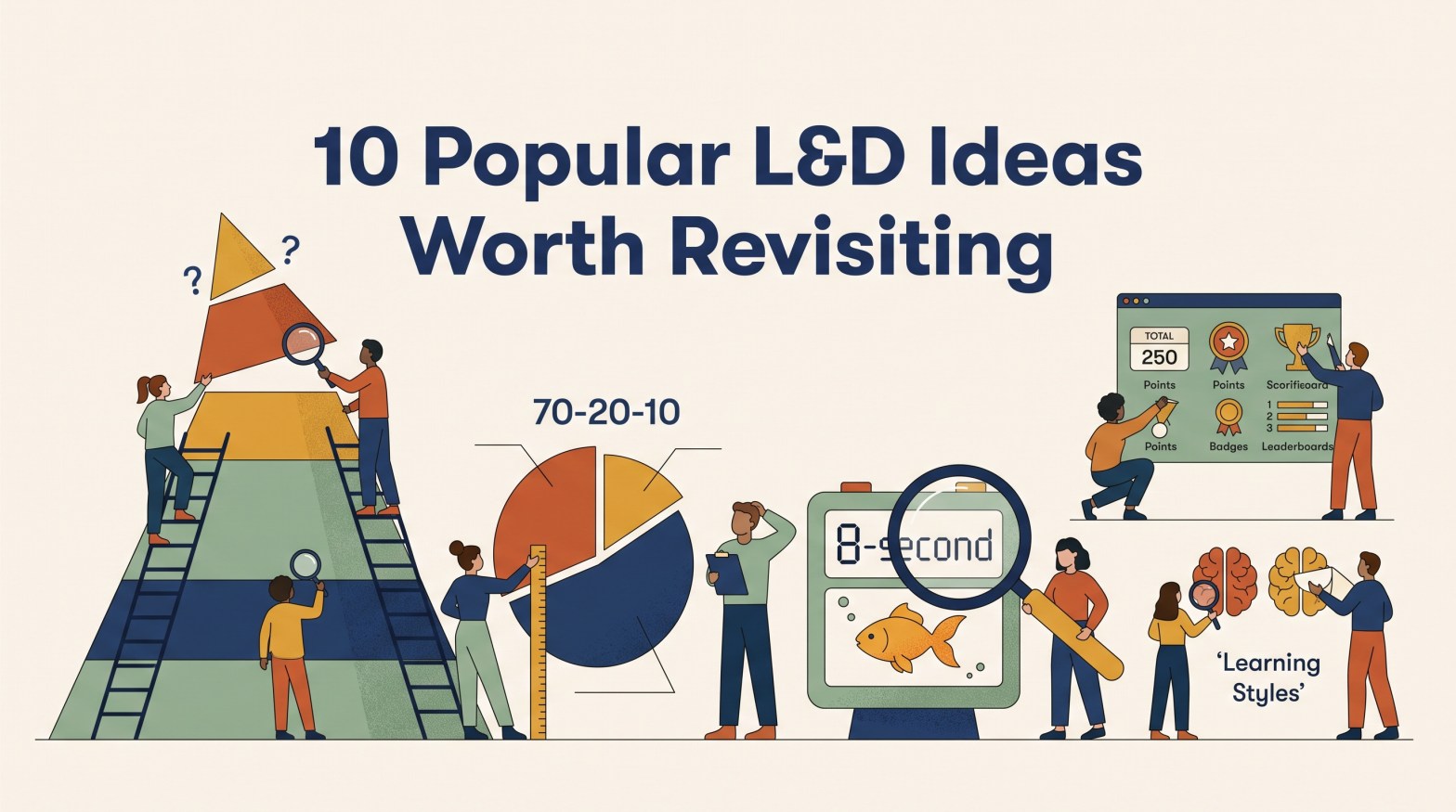
Here are ten L&D ideas that became simpler, more certain, and sometimes less accurate as they traveled.
1. People Learn Best in Their Learning Style
Verdict:  Myth
Myth
Visual learners need pictures. Auditory learners need sound. Kinesthetic learners need hands-on practice.
It has a nice ring to it. It also feels respectful. People are different, so surely we should teach each person in the way they prefer.
The first part is true. People do have preferences. The second part is where the evidence weakens.
There has been a lot of research on whether matching instruction to a learner’s preferred style improves outcomes. All of them concluded there was not an adequate evidence base for using learning-style assessments in general educational practice.
That doesn’t mean visuals are bad or hands-on practice has no value. The best format often depends on the content. A map helps people navigate. Audio helps with pronunciation. Physical practice helps when learning a physical skill.
The content should guide the method, not a label attached to the learner.
Takeaway: Preferences are real. The evidence supporting instruction matched to individual learning styles is much weaker than many people assume.
Sources
- Pashler, H., McDaniel, M., Rohrer, D., and Bjork, R. (2009). Learning Styles: Concepts and Evidence.
- Coffield, F., Moseley, D., Hall, E., and Ecclestone, K. (2004). Learning Styles and Pedagogy in Post-16 Learning.
2. 70-20-10 Is a Proven Formula
Verdict:  Useful Idea, Weak Evidence
You probably know the numbers:
- 70% from experience
- 20% from other people
- 10% from formal learning
They’re easy to remember, which may explain why so many people started treating them as a formula rather than an observation.
The model grew from reports about how successful managers believed they had developed during their careers. It wasn’t a controlled experiment proving that everyone learns in those exact ratios.
Researcher Alan Clardy reviewed the evidence and argued that support for the specific percentages was far weaker than many practitioners assume.
None of that makes workplace experience unimportant. People clearly learn through assignments, coaching, observation, feedback, and mistakes. The issue is that an observation gradually became a prescription. Somewhere along the way, a useful reminder to look beyond formal training started being treated like a universal rule.
Takeaway: Use 70-20-10 as a prompt to think broadly about development, not as arithmetic you must obey.
Sources
- Lombardo, M., and Eichinger, R. (1996). The Career Architect Development Planner.
- Clardy, A. (2018). 70-20-10 and the Dominance of Informal Learning: A Fact in Search of Evidence.
3. Bloom’s Taxonomy Is a Staircase
Verdict: Useful Model, Often Misapplied
Most of us know Bloom’s as six levels stacked in a pyramid:
Remember. Understand. Apply. Analyze. Evaluate. Create.
That image encourages a tidy story. Start at the bottom, move upward, and aim for the top because creating is always best.
The real story is more nuanced.
Bloom’s original taxonomy was designed to classify educational objectives and create a shared language for discussing them. It included a hierarchy, but it wasn’t intended as a universal instructional process that every lesson must follow.
Creating isn’t automatically the right goal. If I’m learning an emergency procedure, accurate recall may matter far more than producing something new. Experts also move back and forth among different types of thinking rather than climbing a ladder one rung at a time.
Takeaway: Bloom’s can help align goals, instruction, and assessment. It shouldn’t dictate a rigid sequence for every learning experience.
Sources
- Bloom, B. (1956). Taxonomy of Educational Objectives.
- Anderson, L., and Krathwohl, D. (2001). A Taxonomy for Learning, Teaching, and Assessing.
- Hendrick, C. The Untold Story of Bloom’s Taxonomy.
4. People Remember 90 Percent of What They Do
Verdict: Myth
You’ve probably seen the graphic.
People remember:
- 10% of what they read
- 20% of what they hear
- 90% of what they do
Those numbers are frequently connected to Edgar Dale’s Cone of Experience.
Perhaps the most surprising part of the famous retention chart is that the percentages most people remember never appeared in Dale’s original work.
His cone described different types of learning experiences ranging from more concrete to more abstract. The retention statistics appeared later and have no clear research foundation.
That doesn’t mean practice is ineffective. Practice can be incredibly valuable. But retention depends on many factors, including prior knowledge, attention, retrieval, feedback, spacing, and context. No honest chart can reduce all of that complexity to three neat percentages.
Takeaway: Learning by doing can be powerful. The famous retention numbers are not supported by strong evidence.
Sources
- Dale, E. (1946). Audio-Visual Methods in Teaching.
- Thalheimer, W. (2006). People Remember 10%, 20%…Oh Really?
5. People Have an Eight-Second Attention Span
Verdict: Myth
The story goes like this:
Human attention spans have shrunk to eight seconds. That’s supposedly shorter than a goldfish.
Therefore, every learning experience should be tiny.
It’s a memorable claim. It’s just not a well-supported one.
While attention is undoubtedly affected by our environment, researchers have struggled to find evidence supporting a universal eight-second human attention span. People still lose themselves in novels, hobbies, games, and multi-hour projects.
The issue isn’t that humans suddenly forgot how to focus. It’s that attention now competes with more distractions than ever.
Takeaway: Don’t design around a goldfish statistic. Earn attention through relevance, clarity, challenge, and good pacing.
6. Adults Learn in a Completely Different Way Than Children
Verdict: Useful Perspective, Ongoing Debate
Adult Learning Theory gave L&D an important reminder: adults bring experience, responsibilities, motivations, and a need for relevance.
The trouble begins when those useful observations become a rigid divide.
Adults are self-directed. Children are dependent. Adults are internally motivated. Children are externally motivated.
Real people are messier than that.
Recent critiques have questioned whether adult and child learning differ as sharply as andragogy is often portrayed. Some scholars argue that while adults and children may learn in different contexts, the underlying mechanisms of learning are often more similar than traditional descriptions suggest.
That’s not an argument against relevance, autonomy, or experience. It’s a reminder that human learning is usually more complicated than a checklist.
Takeaway: Design for the people and situation in front of you, not for a simplified description of what all adults supposedly have in common.
Sources
- Knowles, M. (1973). The Adult Learner: A Neglected Species.
- Knowles, M. (1980). The Modern Practice of Adult Education.
- Moll, I. (2024). A Psychological Critique of Knowles’ Andragogy as a Theory of Learning.
7. Kirkpatrick Proves the Training Worked
Verdict: Useful Framework, Often Oversimplified
The problem with Kirkpatrick isn’t Kirkpatrick. It’s the tidy staircase many of us were taught.
Too often, the four levels become a checklist: Did people like the training? Did they pass the test? Did their behavior change? Did business results improve?
That creates a neat story from Reaction to Results. But a neat story is not proof. Each connection still needs evidence.
The updated model is more connected and iterative than the familiar staircase suggests. It starts with the results an organization needs, works backward to the behaviors that support them, and asks what must happen on the job to sustain those behaviors. Training is only one part of that system.
So the question isn’t whether Kirkpatrick is right or wrong. It’s whether we use the model to guide better questions or treat it as automatic proof that training caused the result.
Takeaway: Use Kirkpatrick to build a chain of evidence, not a ladder of assumptions. Start with the result, identify the behavior that could influence it, and test each connection.
Sources
- Kirkpatrick, J. D., & Kirkpatrick, W. K. (2016). Kirkpatrick’s Four Levels of Training Evaluation. ATD Press.
- Cahapay, M. (2021). Kirkpatrick Model: Its Limitations as Used in Higher Education Evaluation.
8. Engagement Means Learning
Verdict: Useful Measure, Weak Evidence
The room was lively. The chat was flying. Learners were clicking, commenting, laughing, and participating.
Success, right?
Maybe.
One of the easiest traps in L&D is confusing evidence of activity with evidence of learning. The two often overlap, but they’re not the same thing.
Researchers and learning scientists have long argued that learners are not especially good judges of their own learning. In Make It Stick, Brown, Roediger, and McDaniel describe how learners often mistake familiarity, fluency, and enjoyment for durable learning. Techniques that feel easy and engaging can create an illusion of learning, while techniques that feel more difficult may produce stronger long-term retention.
The same theme appears throughout How Learning Happens by Paul Kirschner and Carl Hendrick. Learning is not always obvious while it’s happening. A learner can feel confident without learning much, and they can feel challenged or uncertain while making significant progress.
That doesn’t mean engagement is unimportant. Few people learn effectively when they are distracted, confused, or completely disengaged. Attention matters. Motivation matters. Participation matters.
The problem comes when we stop there.
A crowded discussion board doesn’t prove understanding. High completion rates don’t prove retention. A great satisfaction score doesn’t prove behavior change or improved performance.
In other words, engagement may be a useful leading indicator, but it’s a poor substitute for evidence that learning actually occurred.
Takeaway: Engagement can support learning, but it isn’t learning. Measure attention, participation, and satisfaction if they’re useful. Just don’t mistake them for retention, transfer, or performance improvement.
Sources
- Brown, P., Roediger, H., and McDaniel, M. (2014). Make It Stick: The Science of Successful Learning.
- Kirschner, P., and Hendrick, C. (2020). How Learning Happens.
- Clark, R., and Mayer, R. (2023). e-Learning and the Science of Instruction.
9. Microlearning Is Better
Verdict:  Context Dependent
Unlike some items on this list, microlearning has meaningful evidence behind it.
Recent systematic reviews have reported generally positive outcomes across multiple studies while also noting significant variation in definitions, implementation approaches, and research methods.
The issue isn’t that microlearning never works. The issue is that “make it shorter” has become an answer before we’ve asked the question.
A short lesson may be ideal for a refresher, job aid, or narrowly focused task. Building a complex skill is a different challenge entirely. Some capabilities require time, feedback, repetition, coaching, and sustained practice.
Breaking a weak course into ten shorter pieces doesn’t improve the content. It simply gives you ten smaller pieces of weak content.
Takeaway: Short is a format, not a strategy. Good design starts with the need.
Sources
- Monib, W., Qazi, A., and Apong, R. (2025). Microlearning Beyond Boundaries: A Systematic Review and a Novel Framework for Improving Learning Outcomes.
10. Gamification Works
Verdict: Context Dependent
Points. Badges. Leaderboards.
Done, right?
Not quite.
Research generally supports the idea that well-designed gamification can improve learning outcomes. However, the size of those effects varies considerably depending on the audience, content, design approach, duration, and learning environment.
That’s a much more useful conclusion than either extreme: “Gamification works” or “Gamification is a gimmick.”
A leaderboard may motivate one audience and discourage another. A storyline may add meaning or add noise. A challenge may promote useful practice or reward speed on the wrong task.
Like most instructional tools, it depends on how it’s used.
Takeaway: Game elements are ingredients. Their value depends on what you’re trying to make.
Sources
- Li, M., Ma, S., and Shi, Y. (2023). Examining the Effectiveness of Gamification as a Tool Promoting Teaching and Learning in Educational Settings: A Meta-Analysis.
- Kapp, K. (2012). The Gamification of Learning and Instruction.
The Bigger Lesson
The point isn’t that L&D has been foolish. It’s that useful ideas change as they travel.
A model starts with nuance. Someone trims it for a workshop. Someone turns it into a pyramid. A memorable statistic gets attached. Before long, the simplified version becomes easier to remember than the source.
That’s how a guide becomes a rule, a ratio becomes a law, and a preference becomes a learning need. The transformation happens gradually, usually with good intentions. Each simplification makes the idea easier to teach and remember. Unfortunately, it can also make the idea less accurate.
We don’t need to throw away every familiar model. We do need to hold them a little more lightly.
Ask where an idea came from. Check what the original source actually claimed. Look for the limits, not just the headline. Then decide whether the model fits the problem in front of you.
Models help us think. Problems begin when we stop thinking and let the model do it for us.
The goal isn’t to collect more frameworks. It’s to stay curious enough to revisit the ones we already know.
Because in a profession built around learning, some of the most valuable lessons come from what we’re willing to unlearn.








You must be logged in to post a comment.