Tag: Learning Theory

  • Friday Finds | December 1, 2017

    Friday Finds | December 1, 2017

    Our march towards the holiday season has begun. Leading the way is a gift that keeps on giving — smart insights from smart people. Intentionally building your own personal network will net you a lifetime of amazing gifts, like the ones I’ve rounded up for you here.

    ““If you want to know what a man’s like, take a good look at how he treats his inferiors, not his equals.”   ― J.K. Rowling

    Perspectives on new work

    Coming in at over 100 pages, this one is definitely one for a lazy weekend or some other bigger window when you’ve got some time to take it in. The essence of what appeals to me in this piece edited by Esko Kilpi ( @EskoKilpi ) is captured in by this line:

    Smarter and smarter tools surround us, but if we don’t want to learn the new practices and take up the new roles that the new technologies make possible, they might as well not be there.

    https://www.sitra.fi/en/publications/perspectives-new-work/

    Harold Jarche has a brief synopsis if you’d like to check that out before taking a deeper dive.

    Run Your Own LRS in 4-Weeks

    https://vimeo.com/234470576

    This course from HT2Labs ( @HT2Labs ) focuses on the technical side of xAPI: getting up-and-running with a Learning Record Store. You won’t need to be a programmer to take part, but you will need some experience of implementing servers, software and systems administration in general.

    You’ll also need access to a server (either on cloud, like AWS, or on your own devices) and administration rights to install new software. (For the server bit, you can use Google Cloud Platform)

    https://www.ht2labs.com/resources/free-lrs-mooc/

    Laptops Are Great. But Not During a Lecture or a Meeting.

    This NY Times article by Susan Dynarski ( @dynarski ) takes a look at the growing body of evidence showing that overall, students learn less when they use computers or tablets during lectures.

    http://nyti.ms/2iQtuAA

    How to Access Lynda.com for Free

    Whether you’re learning a new software application at work or getting up to speed with the latest technology at home, odds are that Lynda.com has something for you. The secret to getting free access is your local library.

    https://mike-taylor.org/2017/11/29/how-to-access-lynda-courses-for-free/

    Lean-in Listening

    Lea Pica Podcast

    Lea Pica (@LeaPica) is on a mission to help “present information in a way that gets remembered and inspires action.” You should pop over to Lea’s blog and subscribe. Her recent podcast with Dustin Mathews ( @dustinmathews ), is just one of many reasons. Among the gems I took away from this episode are:

    • Why assigning an advocate to introduce you as presenter is mission critical
    • How to elicit engagement from your audience without putting them on the spot
    • Supercritical steps to take to maximize the effectiveness of product webinars
    • Neat tricks to stand out to your stakeholders such as video presentation teasers

    http://leapica.com/podcast-029-dustin-mathews/

    Interested in more things like this that didn’t make the cut here?
    Follow me on Twitter or even better, subscribe to my newsletter.

  • Marketers Know About the Lizard Brain. Do you?

    Marketers Know About the Lizard Brain. Do you?

    A quick poll before we begin.

    What is the first thing you do when you try to persuade others to do something? Intuition tells most of us to line up a set of facts and figures that make a logical appeal to our audience. After all, once people have the facts, the choice will be easy and obvious. Right?

    The challenge with intuition is that sometimes it is wrong. Let me explain.

    Humans have two types of thinking:

    1. Conscious / logical
    2. Subconscious / emotional

    Our conscious mind is slow, rational and deliberative. It is the part of our thinking that we use for analysis, reasoning and deliberate thought.

    In contrast, our subconscious mind is insanely fast, reflexive and automatic. Besides autonomous systems like breathing, etc. our subconscious brain also handles things like our survival and emotions. It is what we have used for millennia to assess and react to threatening situations. This type of thought is dominant and happens without us even being aware of it.

    For most people, it is surprising to learn that the subconscious mind controls 95% to 99% of human behavior.  TWEET THIS!

    It is important to note that our logical mind is not in control of our actions. And logic is not what persuades others.

    Most marketers know this while most people in training and learning development don’t. This is how I illustrate the difference.

    What are those marketing people doing that we aren’t? They’re talking to our subconscious “lizard brain”! Because of that, they are MUCH better at getting people’s attention and helping them think and act in new ways.

    Got questions? Hit me with your best shot in the comments below.

    Tune in next time, when we take a deeper dive into some of the marketing tactics and tools that we should be stealing to use in our learning programs.


    PS – Why “Lizard Brain”? Because it is the part of the brain (brain stem and limbic system) that has evolved with us over the millennia. Whereas, the logical part of our brain (neocortex) is still a relative newbie – it is only about 30,000 years old.

    “When dealing with people, let us remember we are not dealing with creatures of logic. We are dealing with creatures of emotion, creatures bristling with prejudices and motivated by pride and vanity.”

    ― Dale Carnegie, How to Win Friends and Influence People

  • 3 Easy Ways to Cut Text And Upgrade Your Slides

    3 Easy Ways to Cut Text And Upgrade Your Slides

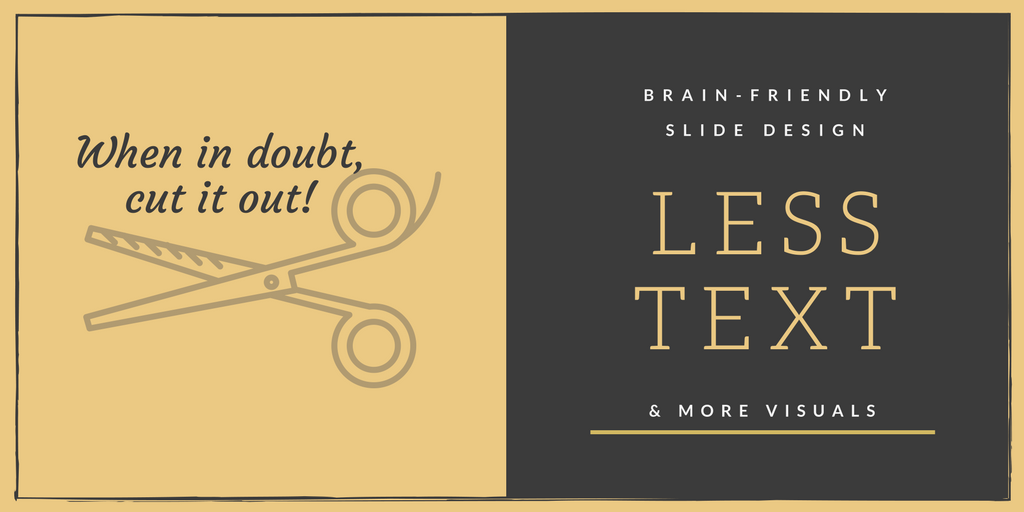
    Reading your slides is public enemy #1 when it comes to presenting and your audience hates it more than anything! And if you do it because you want to reach visual learners, there is no such thing. Research shows that when people both hear and see the same verbal message they have trouble focusing on either one.

    Use the Notes pane.

    Many people use their slides as teleprompters. A better approach is to use the Notes pane for your speaker notes and other personal reminders. This way you can have the best of both worlds. You’ll see your speaker notes privately and keep your slides nice and clean. So, if you like your teleprompter you can keep your teleprompter — just don’t force it on your audience!

    If you like your teleprompter, you can keep your teleprompter.

    Build your slides for your audience and keep your notes for yourself.

    Make Only One Point Per Slide

    A great thing about building slides is that they are free. It doesn’t cost anything to use additional slides and it doesn’t take any longer if you spread those three talking points across three different slides. I always cringe when I hear organizations or event planners put a limit on the number of slides. Usually, they’re trying to equate the number of slides to an amount of time. When done well, the number of slides has absolutely nothing to do with how long it takes to present them.

    The number of slides is irrelevant. The flow, pace, and clarity of the message is what matters the most.

    Our brains can only process one idea at a time anyway, so why tax them with a flurry of information all at the same time?

    Create a handout

    Where do you put all the facts, figures and other supplemental details related to your topic? In the handout you create specifically for that purpose. Creating a separate handout lets your slides carry your message effectively and efficiently with visuals and the power of emotions without getting bogged down in all the minutiae.

    Repeat after me. Good slides to not make good handouts.

    If all you want to do is create a file of facts and figures, then cancel the meeting and send in a report. – Seth Godin

    A good handout helps your audience pay attention and engage with you instead of furiously trying to scribble down numbers, websites or other stats they want to remember.

    I’d love to hear what you do in your work. Do you have similar approaches or take a different angle?