
A free tool that walks you and your stakeholders through Mager and Pipe’s performance flowchart, before anyone opens an authoring tool.
Here’s a made-up request. You’ve seen one like it.
An ops manager emails: “My reps keep skipping call notes in the CRM. Can you build a refresher course?”
So you ask a few questions. The reps know the standard. It’s in the handbook. They covered it in onboarding. But the note field sits three screens deep. They get about ten seconds between calls. And the only number anyone tracks is handle time, so every note they write makes them look slower.
Now, picture the refresher course. It’s well designed. Reps pass the quiz. Then they go back to the same screens, the same ten seconds, and the same scorecard.
Nothing changes. Nothing could have.
Training fixes one thing
Training helps people who don’t know how to do something. That’s it.
If people already know how, a course can’t help. Maybe the right way is slow. Maybe the wrong way pays off. Maybe nobody notices either way. In every one of those cases, training has zero chance of working.
Yet it’s still the default answer. It’s visible. It’s easy to order. It looks like action. The real fixes, like clear expectations, better tools, honest feedback, and incentives that make sense, never come up. Nobody asks the questions that would surface them.
So I built a tool that asks them for you.
Meet the Performance Problem Navigator
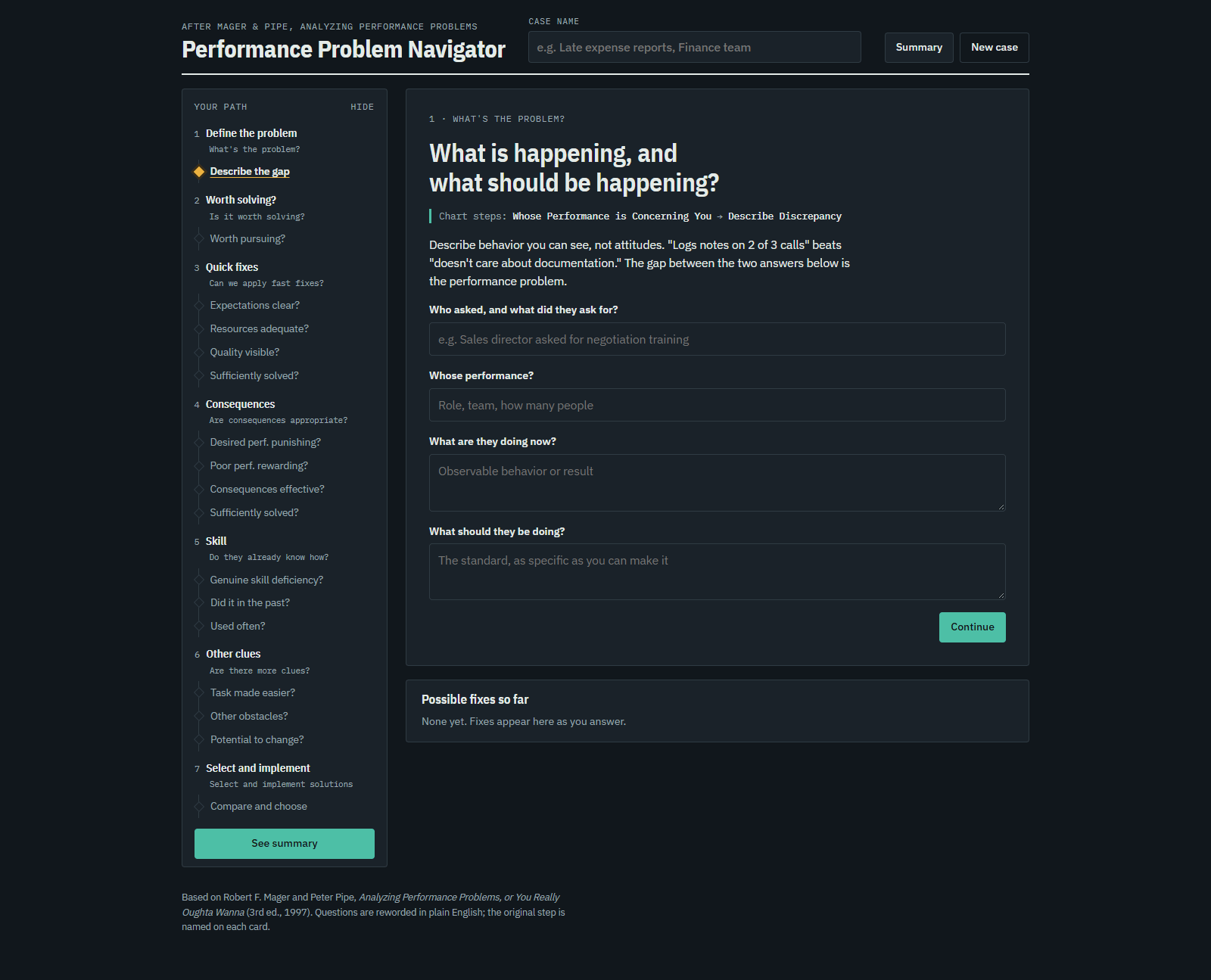
The Performance Problem Navigator is a free, interactive version of Mager and Pipe’s performance analysis flowchart. Open it with your stakeholder. Answer one question at a time. By the end, you’ll know whether training can fix the problem, and what to do if it can’t.
Try the Performance Problem Navigator
Training is the last box on the chart
Robert Mager and Peter Pipe first published Analyzing Performance Problems in 1970. The Navigator follows the flowchart from the 1997 edition. It moves through six questions, in order:
- What’s the problem? What’s happening, and what should be?
- Is it worth solving? Some problems cost less to live with than to fix.
- Can we apply fast fixes? Clear expectations, enough resources, visible results.
- Are consequences appropriate? Is the right way punished, or the wrong way rewarded?
- Do they already know how? Is there a real skill gap?
- Are there more clues? Can the task be easier? What else is in the way?
Look where training lands. It’s the very last box. Fifteen decisions come first. That order is the lesson.
What you get that a paper chart can’t give you
A chart on the wall doesn’t run the meeting. The Navigator does.
- Your stakeholder can follow along. Every question is in plain English, with the original chart step named underneath.
- You’ll never stall. Each step gives you questions to ask out loud.
- Nothing gets lost. You capture evidence as you go, in their words.
- “I don’t know” won’t derail you. “Not sure” is an answer. It gets flagged as an open question instead of a guess.
- You walk out with something to send. The summary gives a bottom line on training, the fixes found, open questions, and an action plan. Copy it into an email.
The hardest conversation gets easier
That summary is the part I care about most.
Telling someone “training won’t fix this” is one of the toughest moments in L&D. They asked for a course. You’re saying no. It can feel like you’re refusing to help.
The summary changes that. You’re not giving your opinion. You’re handing back their own answers, in order, with the fixes they point to. It’s hard to argue with what you just said yourself.
The one question that matters most
If you remember one step, make it this one: do they really lack the skill?
Mager and Pipe’s test is simple. If their job depended on it, could they do it right now? If yes, it’s not a training problem. Full stop.
Try it on your next request
Pick the next training request that lands in your inbox. Before you open your authoring tool, open the Navigator.
If the answer is training, great. Now you know it can work. If it isn’t, you may have just saved weeks building something that never stood a chance.