Category: Performance Improvement

  • Stop Building Training That Was Never Going to Work

    Stop Building Training That Was Never Going to Work

    A free tool that walks you and your stakeholders through Mager and Pipe’s performance flowchart, before anyone opens an authoring tool.

    Here’s a made-up request. You’ve seen one like it.

    An ops manager emails: “My reps keep skipping call notes in the CRM. Can you build a refresher course?”

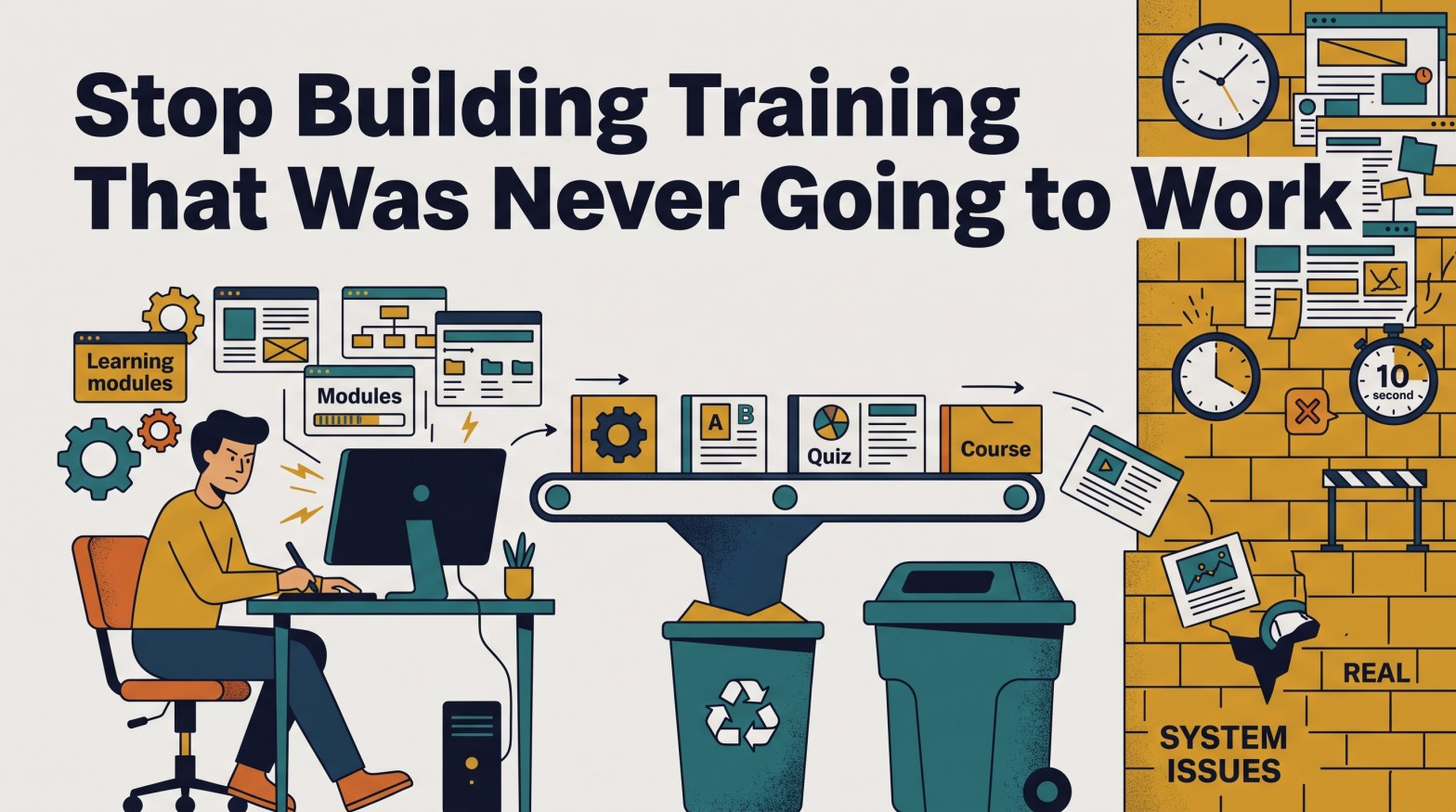
    So you ask a few questions. The reps know the standard. It’s in the handbook. They covered it in onboarding. But the note field sits three screens deep. They get about ten seconds between calls. And the only number anyone tracks is handle time, so every note they write makes them look slower.

    Now, picture the refresher course. It’s well designed. Reps pass the quiz. Then they go back to the same screens, the same ten seconds, and the same scorecard.

    Nothing changes. Nothing could have.

    Training fixes one thing

    Training helps people who don’t know how to do something. That’s it.

    If people already know how, a course can’t help. Maybe the right way is slow. Maybe the wrong way pays off. Maybe nobody notices either way. In every one of those cases, training has zero chance of working.

    Yet it’s still the default answer. It’s visible. It’s easy to order. It looks like action. The real fixes, like clear expectations, better tools, honest feedback, and incentives that make sense, never come up. Nobody asks the questions that would surface them.

    So I built a tool that asks them for you.

    Meet the Performance Problem Navigator

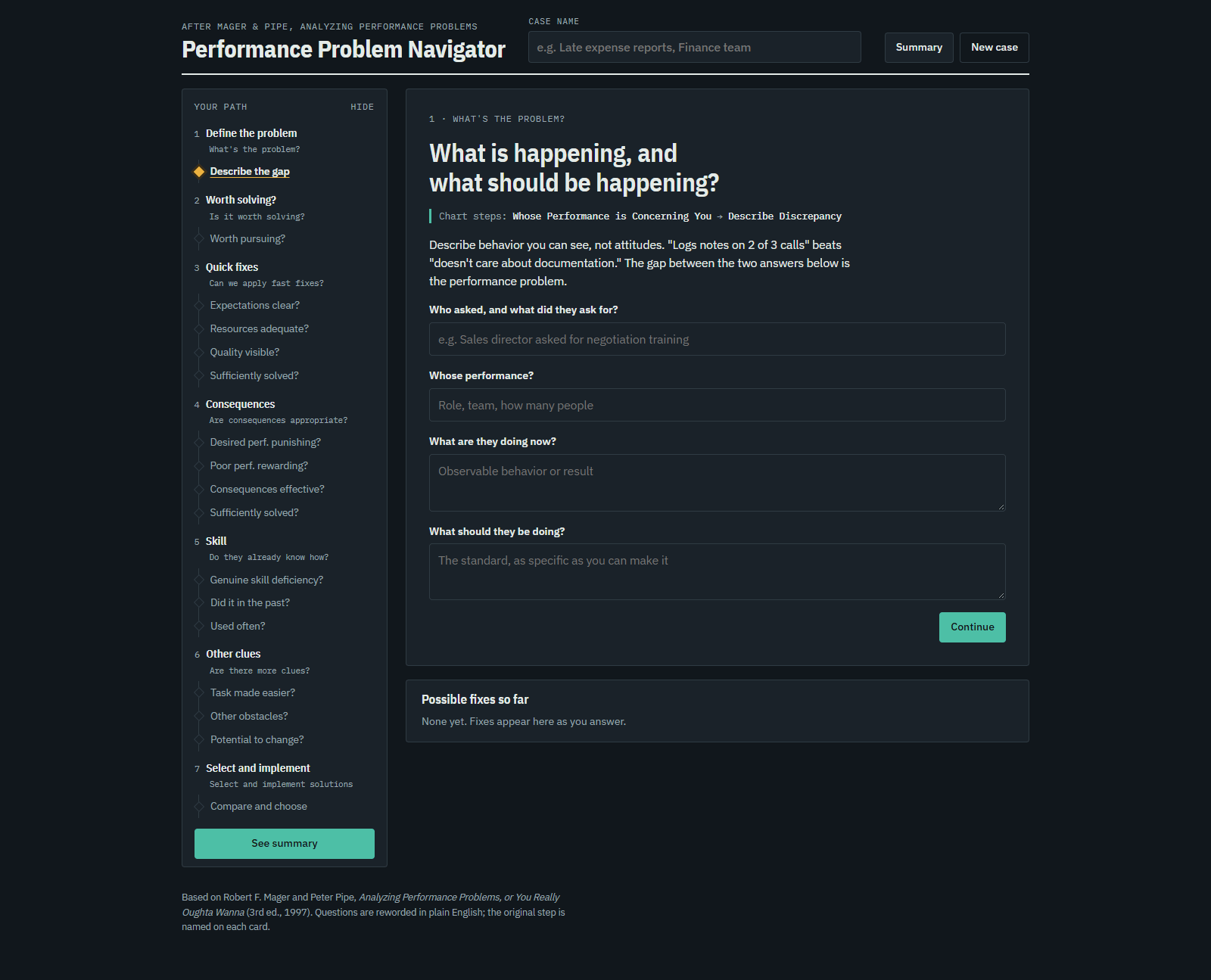
    The Performance Problem Navigator is a free, interactive version of Mager and Pipe’s performance analysis flowchart. Open it with your stakeholder. Answer one question at a time. By the end, you’ll know whether training can fix the problem, and what to do if it can’t.

    Try the Performance Problem Navigator

    Training is the last box on the chart

    Robert Mager and Peter Pipe first published Analyzing Performance Problems in 1970. The Navigator follows the flowchart from the 1997 edition. It moves through six questions, in order:

    1. What’s the problem? What’s happening, and what should be?
    2. Is it worth solving? Some problems cost less to live with than to fix.
    3. Can we apply fast fixes? Clear expectations, enough resources, visible results.
    4. Are consequences appropriate? Is the right way punished, or the wrong way rewarded?
    5. Do they already know how? Is there a real skill gap?
    6. Are there more clues? Can the task be easier? What else is in the way?

    Look where training lands. It’s the very last box. Fifteen decisions come first. That order is the lesson.

    What you get that a paper chart can’t give you

    A chart on the wall doesn’t run the meeting. The Navigator does.

    • Your stakeholder can follow along. Every question is in plain English, with the original chart step named underneath.
    • You’ll never stall. Each step gives you questions to ask out loud.
    • Nothing gets lost. You capture evidence as you go, in their words.
    • “I don’t know” won’t derail you. “Not sure” is an answer. It gets flagged as an open question instead of a guess.
    • You walk out with something to send. The summary gives a bottom line on training, the fixes found, open questions, and an action plan. Copy it into an email.

    The hardest conversation gets easier

    That summary is the part I care about most.

    Telling someone “training won’t fix this” is one of the toughest moments in L&D. They asked for a course. You’re saying no. It can feel like you’re refusing to help.

    The summary changes that. You’re not giving your opinion. You’re handing back their own answers, in order, with the fixes they point to. It’s hard to argue with what you just said yourself.

    The one question that matters most

    If you remember one step, make it this one: do they really lack the skill?

    Mager and Pipe’s test is simple. If their job depended on it, could they do it right now? If yes, it’s not a training problem. Full stop.

    Try it on your next request

    Pick the next training request that lands in your inbox. Before you open your authoring tool, open the Navigator.

    If the answer is training, great. Now you know it can work. If it isn’t, you may have just saved weeks building something that never stood a chance.

  • 10 Popular L&D Ideas Worth Revisiting

    10 Popular L&D Ideas Worth Revisiting

    Recently, I read The Untold Story of Bloom’s Taxonomy by Carl Hendrick.

    That name instantly took me back.

    Like many people in Learning and Development, I was introduced to Bloom’s years ago. I’ve seen it referenced in conference presentations, certification programs, instructional design books, and countless conversations about learning objectives. But as I read the article, I realized something uncomfortable: much of what I thought I knew about Bloom didn’t come from Bloom.

    It came from pyramids, templates, conference talks, and other people who had learned it the same way.

    That made me wonder:

    How many L&D “facts” are actually simplified versions of the original idea?

    This isn’t an attempt to tear down the profession’s favorite models. Most became popular because they’re useful. But useful isn’t the same as proven, and a model isn’t a law.

    Ideas also change as they travel. Someone trims a complex concept for a workshop. Someone else turns it into a graphic. A catchy statistic gets added. Eventually, the simplified version becomes easier to remember than the source.

    And that’s when things get interesting.

    The goal isn’t to debunk these ideas. It’s to revisit them. Some turn out to be myths. Some are good models that have been stretched beyond their original purpose. Others work quite well, but only under the right conditions.

    Here are ten L&D ideas that became simpler, more certain, and sometimes less accurate as they traveled.


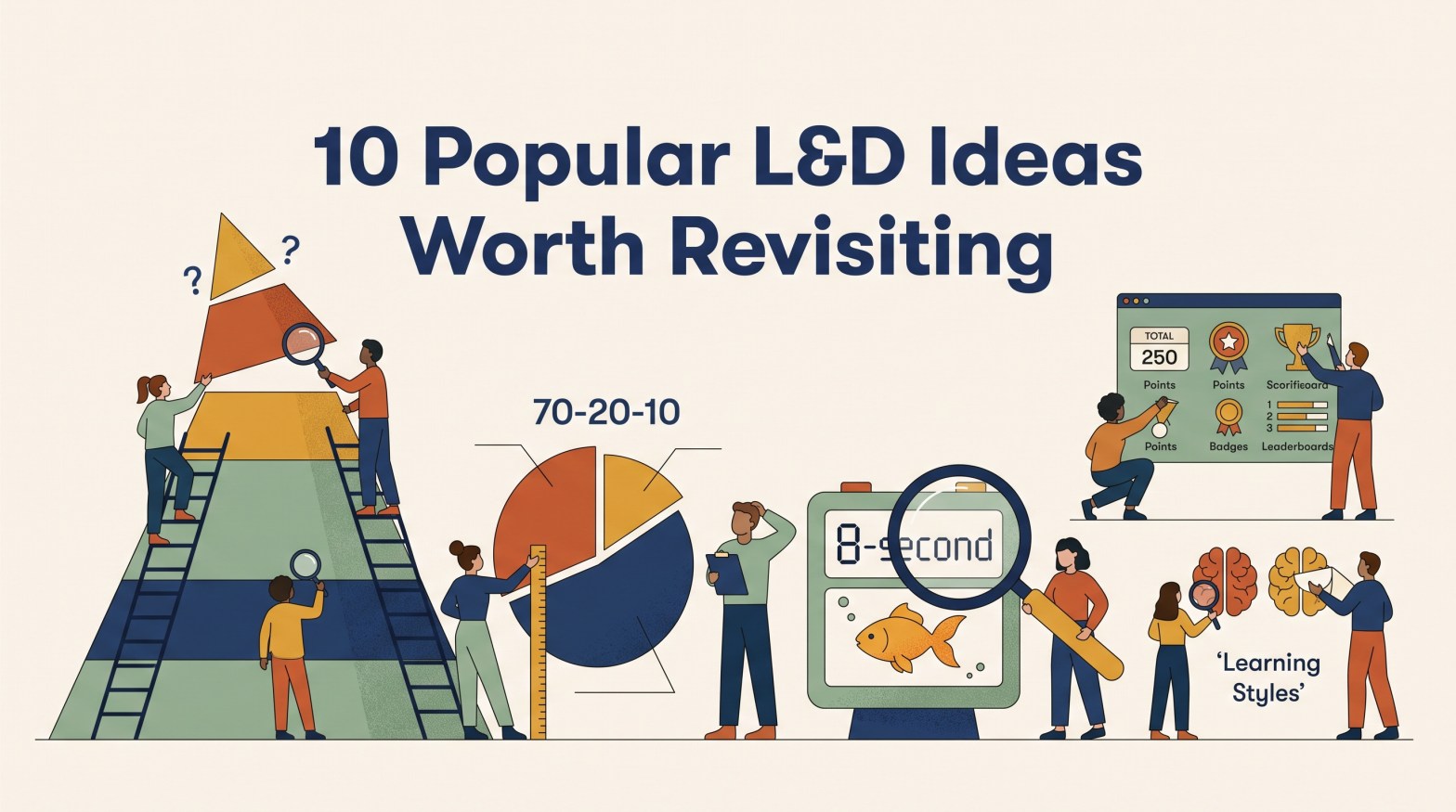
    1. People Learn Best in Their Learning Style

    Verdict: 🚫 Myth

    Visual learners need pictures. Auditory learners need sound. Kinesthetic learners need hands-on practice.

    It has a nice ring to it. It also feels respectful. People are different, so surely we should teach each person in the way they prefer.

    The first part is true. People do have preferences. The second part is where the evidence weakens.

    There has been a lot of research on whether matching instruction to a learner’s preferred style improves outcomes. All of them concluded there was not an adequate evidence base for using learning-style assessments in general educational practice.

    That doesn’t mean visuals are bad or hands-on practice has no value. The best format often depends on the content. A map helps people navigate. Audio helps with pronunciation. Physical practice helps when learning a physical skill.

    The content should guide the method, not a label attached to the learner.

    Takeaway: Preferences are real. The evidence supporting instruction matched to individual learning styles is much weaker than many people assume.

    Sources

    • Pashler, H., McDaniel, M., Rohrer, D., and Bjork, R. (2009). Learning Styles: Concepts and Evidence.
    • Coffield, F., Moseley, D., Hall, E., and Ecclestone, K. (2004). Learning Styles and Pedagogy in Post-16 Learning.

    2. 70-20-10 Is a Proven Formula

    Verdict: ⚠️ Useful Idea, Weak Evidence

    You probably know the numbers:

    • 70% from experience
    • 20% from other people
    • 10% from formal learning

    They’re easy to remember, which may explain why so many people started treating them as a formula rather than an observation.

    The model grew from reports about how successful managers believed they had developed during their careers. It wasn’t a controlled experiment proving that everyone learns in those exact ratios.

    Researcher Alan Clardy reviewed the evidence and argued that support for the specific percentages was far weaker than many practitioners assume.

    None of that makes workplace experience unimportant. People clearly learn through assignments, coaching, observation, feedback, and mistakes. The issue is that an observation gradually became a prescription. Somewhere along the way, a useful reminder to look beyond formal training started being treated like a universal rule.

    Takeaway: Use 70-20-10 as a prompt to think broadly about development, not as arithmetic you must obey.

    Sources

    • Lombardo, M., and Eichinger, R. (1996). The Career Architect Development Planner.
    • Clardy, A. (2018). 70-20-10 and the Dominance of Informal Learning: A Fact in Search of Evidence.

    3. Bloom’s Taxonomy Is a Staircase

    Verdict: ⚠️ Useful Model, Often Misapplied

    Most of us know Bloom’s as six levels stacked in a pyramid:

    Remember. Understand. Apply. Analyze. Evaluate. Create.

    That image encourages a tidy story. Start at the bottom, move upward, and aim for the top because creating is always best.

    The real story is more nuanced.

    Bloom’s original taxonomy was designed to classify educational objectives and create a shared language for discussing them. It included a hierarchy, but it wasn’t intended as a universal instructional process that every lesson must follow.

    Creating isn’t automatically the right goal. If I’m learning an emergency procedure, accurate recall may matter far more than producing something new. Experts also move back and forth among different types of thinking rather than climbing a ladder one rung at a time.

    Takeaway: Bloom’s can help align goals, instruction, and assessment. It shouldn’t dictate a rigid sequence for every learning experience.

    Sources

    • Bloom, B. (1956). Taxonomy of Educational Objectives.
    • Anderson, L., and Krathwohl, D. (2001). A Taxonomy for Learning, Teaching, and Assessing.
    • Hendrick, C. The Untold Story of Bloom’s Taxonomy.

    4. People Remember 90 Percent of What They Do

    Verdict: 🚫 Myth

    You’ve probably seen the graphic.

    People remember:

    • 10% of what they read
    • 20% of what they hear
    • 90% of what they do

    Those numbers are frequently connected to Edgar Dale’s Cone of Experience.

    Perhaps the most surprising part of the famous retention chart is that the percentages most people remember never appeared in Dale’s original work.

    His cone described different types of learning experiences ranging from more concrete to more abstract. The retention statistics appeared later and have no clear research foundation.

    That doesn’t mean practice is ineffective. Practice can be incredibly valuable. But retention depends on many factors, including prior knowledge, attention, retrieval, feedback, spacing, and context. No honest chart can reduce all of that complexity to three neat percentages.

    Takeaway: Learning by doing can be powerful. The famous retention numbers are not supported by strong evidence.

    Sources

    • Dale, E. (1946). Audio-Visual Methods in Teaching.
    • Thalheimer, W. (2006). People Remember 10%, 20%…Oh Really?

    5. People Have an Eight-Second Attention Span

    Verdict: 🚫 Myth

    The story goes like this:

    Human attention spans have shrunk to eight seconds. That’s supposedly shorter than a goldfish.

    Therefore, every learning experience should be tiny.

    It’s a memorable claim. It’s just not a well-supported one.

    While attention is undoubtedly affected by our environment, researchers have struggled to find evidence supporting a universal eight-second human attention span. People still lose themselves in novels, hobbies, games, and multi-hour projects.

    The issue isn’t that humans suddenly forgot how to focus. It’s that attention now competes with more distractions than ever.

    Takeaway: Don’t design around a goldfish statistic. Earn attention through relevance, clarity, challenge, and good pacing.


    6. Adults Learn in a Completely Different Way Than Children

    Verdict: ⚠️ Useful Perspective, Ongoing Debate

    Adult Learning Theory gave L&D an important reminder: adults bring experience, responsibilities, motivations, and a need for relevance.

    The trouble begins when those useful observations become a rigid divide.

    Adults are self-directed. Children are dependent. Adults are internally motivated. Children are externally motivated.

    Real people are messier than that.

    Recent critiques have questioned whether adult and child learning differ as sharply as andragogy is often portrayed. Some scholars argue that while adults and children may learn in different contexts, the underlying mechanisms of learning are often more similar than traditional descriptions suggest.

    That’s not an argument against relevance, autonomy, or experience. It’s a reminder that human learning is usually more complicated than a checklist.

    Takeaway: Design for the people and situation in front of you, not for a simplified description of what all adults supposedly have in common.

    Sources

    • Knowles, M. (1973). The Adult Learner: A Neglected Species.
    • Knowles, M. (1980). The Modern Practice of Adult Education.
    • Moll, I. (2024). A Psychological Critique of Knowles’ Andragogy as a Theory of Learning.

    7. Kirkpatrick Proves the Training Worked

    Verdict: ⚠️ Useful Framework, Often Oversimplified

    The problem with Kirkpatrick isn’t Kirkpatrick. It’s the tidy staircase many of us were taught.

    Too often, the four levels become a checklist: Did people like the training? Did they pass the test? Did their behavior change? Did business results improve?

    That creates a neat story from Reaction to Results. But a neat story is not proof. Each connection still needs evidence.

    The updated model is more connected and iterative than the familiar staircase suggests. It starts with the results an organization needs, works backward to the behaviors that support them, and asks what must happen on the job to sustain those behaviors. Training is only one part of that system.

    So the question isn’t whether Kirkpatrick is right or wrong. It’s whether we use the model to guide better questions or treat it as automatic proof that training caused the result.

    Takeaway: Use Kirkpatrick to build a chain of evidence, not a ladder of assumptions. Start with the result, identify the behavior that could influence it, and test each connection.

    Sources

    • Kirkpatrick, J. D., & Kirkpatrick, W. K. (2016). Kirkpatrick’s Four Levels of Training Evaluation. ATD Press.
    • Cahapay, M. (2021). Kirkpatrick Model: Its Limitations as Used in Higher Education Evaluation.

    8. Engagement Means Learning

    Verdict: ⚠️ Useful Measure, Weak Evidence

    The room was lively. The chat was flying. Learners were clicking, commenting, laughing, and participating.

    Success, right?

    Maybe.

    One of the easiest traps in L&D is confusing evidence of activity with evidence of learning. The two often overlap, but they’re not the same thing.

    Researchers and learning scientists have long argued that learners are not especially good judges of their own learning. In Make It Stick, Brown, Roediger, and McDaniel describe how learners often mistake familiarity, fluency, and enjoyment for durable learning. Techniques that feel easy and engaging can create an illusion of learning, while techniques that feel more difficult may produce stronger long-term retention.

    The same theme appears throughout How Learning Happens by Paul Kirschner and Carl Hendrick. Learning is not always obvious while it’s happening. A learner can feel confident without learning much, and they can feel challenged or uncertain while making significant progress.

    That doesn’t mean engagement is unimportant. Few people learn effectively when they are distracted, confused, or completely disengaged. Attention matters. Motivation matters. Participation matters.

    The problem comes when we stop there.

    A crowded discussion board doesn’t prove understanding. High completion rates don’t prove retention. A great satisfaction score doesn’t prove behavior change or improved performance.

    In other words, engagement may be a useful leading indicator, but it’s a poor substitute for evidence that learning actually occurred.

    Takeaway: Engagement can support learning, but it isn’t learning. Measure attention, participation, and satisfaction if they’re useful. Just don’t mistake them for retention, transfer, or performance improvement.

    Sources

    • Brown, P., Roediger, H., and McDaniel, M. (2014). Make It Stick: The Science of Successful Learning.
    • Kirschner, P., and Hendrick, C. (2020). How Learning Happens.
    • Clark, R., and Mayer, R. (2023). e-Learning and the Science of Instruction.

    9. Microlearning Is Better

    Verdict: ✅ Context Dependent

    Unlike some items on this list, microlearning has meaningful evidence behind it.

    Recent systematic reviews have reported generally positive outcomes across multiple studies while also noting significant variation in definitions, implementation approaches, and research methods.

    The issue isn’t that microlearning never works. The issue is that “make it shorter” has become an answer before we’ve asked the question.

    A short lesson may be ideal for a refresher, job aid, or narrowly focused task. Building a complex skill is a different challenge entirely. Some capabilities require time, feedback, repetition, coaching, and sustained practice.

    Breaking a weak course into ten shorter pieces doesn’t improve the content. It simply gives you ten smaller pieces of weak content.

    Takeaway: Short is a format, not a strategy. Good design starts with the need.

    Sources

    • Monib, W., Qazi, A., and Apong, R. (2025). Microlearning Beyond Boundaries: A Systematic Review and a Novel Framework for Improving Learning Outcomes.

    10. Gamification Works

    Verdict: ✅ Context Dependent

    Points. Badges. Leaderboards.

    Done, right?

    Not quite.

    Research generally supports the idea that well-designed gamification can improve learning outcomes. However, the size of those effects varies considerably depending on the audience, content, design approach, duration, and learning environment.

    That’s a much more useful conclusion than either extreme: “Gamification works” or “Gamification is a gimmick.”

    A leaderboard may motivate one audience and discourage another. A storyline may add meaning or add noise. A challenge may promote useful practice or reward speed on the wrong task.

    Like most instructional tools, it depends on how it’s used.

    Takeaway: Game elements are ingredients. Their value depends on what you’re trying to make.

    Sources

    • Li, M., Ma, S., and Shi, Y. (2023). Examining the Effectiveness of Gamification as a Tool Promoting Teaching and Learning in Educational Settings: A Meta-Analysis.
    • Kapp, K. (2012). The Gamification of Learning and Instruction.

    The Bigger Lesson

    The point isn’t that L&D has been foolish. It’s that useful ideas change as they travel.

    A model starts with nuance. Someone trims it for a workshop. Someone turns it into a pyramid. A memorable statistic gets attached. Before long, the simplified version becomes easier to remember than the source.

    That’s how a guide becomes a rule, a ratio becomes a law, and a preference becomes a learning need. The transformation happens gradually, usually with good intentions. Each simplification makes the idea easier to teach and remember. Unfortunately, it can also make the idea less accurate.

    We don’t need to throw away every familiar model. We do need to hold them a little more lightly.

    Ask where an idea came from. Check what the original source actually claimed. Look for the limits, not just the headline. Then decide whether the model fits the problem in front of you.

    Models help us think. Problems begin when we stop thinking and let the model do it for us.

    The goal isn’t to collect more frameworks. It’s to stay curious enough to revisit the ones we already know.

    Because in a profession built around learning, some of the most valuable lessons come from what we’re willing to unlearn.
  • Five Studies That Shaped My Thinking About Training

    Five Studies That Shaped My Thinking About Training

    When training fails, our first instinct is often to add something.

    Another explanation. Another example. Another module. Maybe a quiz with three answers nobody could possibly get wrong.

    But what if content isn’t the problem?

    I recently reviewed 50 studies from psychology, behavioral science, and learning research. I chose them for their influence, historical value, and usefulness at work.

    Several of them highlight that training isn’t always the answer.

    Here are five that changed how I think about performance.

    Get the complete 50-study field guide

    Want the other 45? I compiled all 50 studies, along with their limitations, workplace applications, and practical ideas, into a free field guide.

    ​

    ​

    A layout problem can become a learning problem

    Picture a diagram on one side of a screen and its explanation on the other. Your eyes bounce back and forth. Meanwhile, your brain tries to hold one piece in memory while searching for the next. That mental juggling has a cost. Paul Chandler and John Sweller called it the split-attention effect. When people must combine related information from different places, the layout itself can interfere with learning.

    Split attention—and related attention problems—can appear when we:

    • Put a legend far from the visual it explains
    • Separate instructions from the task
    • Make employees switch between systems to assemble one answer
    • Show visuals that compete with the narration
    • Add decoration that steals attention

    The lesson is not “make everything shorter.” It is this:

    Make important relationships easier to see.

    Try this: Find one screen that separates information people must understand together. Put those pieces side by side—but don’t duplicate information that already makes sense on its own. ​

    ​

    Remembering beats reviewing

    Rereading feels productive.

    The words look familiar. The page makes sense. We nod along and mistake recognition for mastery.

    Then we need the information three days later—and it has vanished.

    Henry Roediger and Jeffrey Karpicke compared repeated study with retrieval practice: asking people to recall what they had learned.

    Repeated study performed better after a very short delay. Retrieval produced stronger retention later.

    That difference matters.

    If people need knowledge on the job, they should practice retrieving it from memory—not merely looking it up again.

    A quiz should not be the inspection station at the end of a course. Used well, it can help create the learning.

    Try this: Before reviewing something you have already taught, ask learners to recall it without looking. Then provide the correct answer and useful feedback.

    Effort helps when success is possible and feedback follows. Blind frustration does not.


    Impact becomes real when it has a face

    Organizational psychologist Adam Grant and his colleagues studied university fundraising callers.

    Some callers met a scholarship student whose education had been funded by their work.

    The script stayed the same. So did the pay.

    But the callers could now picture someone who benefited when they picked up the phone. After meeting the student, they worked longer and raised more money.

    Now compare that with the language we often use to introduce workplace training:

    • Maintain compliance
    • Reduce organizational risk
    • Support strategic priorities
    • Complete this requirement by Friday

    Technically accurate. Emotionally dead.

    Grant studied direct contact with a beneficiary, not whether a good story can rescue a dull compliance course. But the design question travels well:

    Can employees see the person their actions affect?

    Who stays safe? Whose work becomes easier?

    Try this: Replace “This training is important because…” with a real example of someone affected by the behavior.

    Don’t just explain the requirement. Give the consequence a face.


    Information cannot fix a friction problem

    Imagine you know exactly what to do.

    Then you meet the form.

    The instructions are vague. The button you need is buried three menus deep. One approval takes four days, and nobody knows who owns it.

    Would another course help?

    Eric Bettinger and his colleagues studied families applying for college financial aid. One group received personalized information. Another received the same information, plus hands-on help completing and submitting the application.

    The help changed behavior. Information alone did much less.

    The workplace parallel is hard to miss. We prescribe training when the real obstacle is:

    • A confusing form
    • A buried button
    • Too many approvals
    • An unclear process
    • A lack of time
    • A system designed like an escape room

    If people already know what to do, more content is unlikely to save the day.

    Try this: Before building training, watch someone perform the task. Count the clicks, decisions, delays, handoffs, and chances to give up.

    You may not have a knowledge problem. You may have a friction problem.

    Sometimes the right intervention is not better instruction. It is fixing the system.


    A badly framed norm can make behavior worse

    In a well-known field experiment, households learned how their energy use compared with their neighbors’.

    The heavy users cut back.

    But some households that had used less energy began using more. Once they saw the average, they drifted toward it even though that meant doing worse.

    A small sign of approval, a smiley face, stopped that boomerang effect.

    Now consider this workplace message:

    Thirty percent of employees still click suspicious links.

    The intended message is clear:

    This behavior needs to change.

    But employees may hear something else:

    Plenty of people do it. I wouldn’t be unusual.

    Never make the behavior you want to stop sound normal.
    When you use a social norm, make it truthful and pair it with clear approval of the desired behavior.

    If your data support it, you might say:

    Most employees report suspicious messages when something doesn’t look right. Thank you for helping protect your coworkers.

    What if the desired behavior is not common yet?

    Don’t invent a statistic. State the standard:

    Reporting a suspicious message is exactly the response we want. Every report helps protect the people around you.

    Try this: Review one message about poor behavior. Does it make the problem sound normal—or the solution?


    The Bottom Line

    These studies examine different problems, but they point in the same direction:

    Performance depends on more than content.
    People must notice what matters. They must recall it when needed, see a reason to act, have a workable path, and believe the behavior belongs here.

    Training can help.

    But it cannot repair a cluttered design, bring an empty mandate to life, remove a broken process, or overpower a culture that rewards the wrong behavior.

    Sometimes the smartest move is to improve the training.

    Sometimes it is to fix what stands in the way.

    What workplace learning problem should I investigate next?

  • The Best L&D Books Are Not L&D Books

    The Best L&D Books Are Not L&D Books

    (A reading list that makes you useful, fast)

    When someone new to learning design asks a reasonable question:

    “What L&D books should I read?”

    They usually get a long list of L&D books.
    Models. Methods. Frameworks. More models.

    Helpful… up to a point.

    Because the real job of learning design isn’t “build a course.”

    It’s help people do something differently—inside messy systems, with limited time, and zero patience for fluff.

    That’s why the books that make you better at L&D often aren’t labeled “L&D.”

    This list is built for one thing:

    To help you stop building training that changes nothing—and start designing work that gets used.


    Learning sits downstream

    Learning doesn’t live on an island. It lives inside:

    • incentives
    • tools
    • culture
    • managers
    • time pressure
    • bad processes
    • and human laziness (the normal kind)

    So if you only read learning books, you’ll get good at packaging information.

    But behavior doesn’t move because information is well packaged.

    Behavior moves because the situation changes.


    Tier 1: Books that make you useful early

    These are the books I’d hand to a new learning designer because they prevent the classic rookie mistake:

    You build the thing you were asked for… instead of the thing that would help.

    Performance & diagnosis

    • Performance Consulting — Dana & Robinson
      When you’re handed “we need training,” this teaches you how to ask, “Do we?”
    • Good Strategy / Bad Strategy — Richard Rumelt
      When leaders give you goals and call it strategy, this shows you the difference.

    Behavior & action

    • Behavior Change — Susan Michie et al.
      When people “know better” and still don’t do it, this tells you why.
    • Designing for Behavior Change — Stephen Wendel
      When you need action, not awareness, this gives you levers you can actually pull.

    Learning (when learning really is the lever)

    • Design for How People Learn — Julie Dirksen
      When learning is part of the solution, this keeps it focused, practical, and humane.

    Communication & clarity

    • The Pyramid Principle — Barbara Minto
      When your content feels bloated, this teaches you how to think clearly first.
    • Made to Stick — Chip & Dan Heath
      When your message doesn’t land, this shows you what makes ideas memorable.

    Discovery & listening

    • The Mom Test — Rob Fitzpatrick
      When your “needs analysis” is basically polite guessing, this fixes it.

    Tier 1 outcome:
    You stop being an order-taker. You become a problem-solver.


    Bridge Books: translating insight into practice

    Some books aren’t foundations, and they aren’t slow-burn theory either.

    They’re translation layers. They help you change your posture before you change your deliverables.

    They move you from:

    • content-first → audience-first
    • delivery → demand
    • push learning → create pull

    A few that do this well:

    • Think Like a Marketer, Train Like an L&D Pro
      When you’re tired of “mandatory training” energy, this helps you earn attention and design for real humans.
      https://www.amazon.com/Think-Like-Marketer-Train-Pro/dp/1960231197
    • The Power of Moments — Chip & Dan Heath
      When learning feels forgettable, this shows how to design moments people remember—and use.

    Tier 2: Books that make you less naïve

    Tier 2 is what you read after you ship good work… and still watch behavior resist.

    These books teach you the limits.
    And that’s a gift.

    • Nudge — Thaler & Sunstein
      When environment beats explanation (which is often), this shows how to design the path of least resistance.
    • Noise — Kahneman, Sibony, Sunstein
      When inconsistency breaks trust and performance, this helps you see the hidden problem.
    • How Behavior Spreads — Damon Centola
      When adoption stalls, this shows why broadcasting information isn’t enough.
    • The Art of Gathering — Priya Parker
      When workshops and cohorts feel flat, this helps you design the social container.
    • Seeing Like a State — James C. Scott
      When an organization wants a grand rollout, this teaches humility before you scale.

    Tier 2 outcome:
    You stop over-promising what learning can do on its own.


    A note on the L&D classics

    None of this is new.

    Gilbert made environment and supports central to performance.
    Mager & Pipe warned us not to reach for training first.
    Clark & Mayer formalized how cognitive limits shape design.

    So why recommend newer, non-L&D books?

    Because most practitioners don’t struggle with theory.
    They struggle with translation, influence, and getting results in modern workplaces.

    These books often travel further because the language lands with more people.

    This isn’t a replacement of the classics.
    It’s an extension.


    This isn’t anti-L&D

    L&D books matter.

    But they work best as integrators—books that help you apply ideas from behavior, systems, and communication to learning.

    If you treat L&D as the whole world, you end up building content in a vacuum.

    If you treat learning as one lever inside a system, you get much better results.


    How to use this list (without turning it into homework)

    1. Start with Tier 1. Pick two and read with a project in mind.
    2. Add one bridge book. Use it to reshape how you pitch and package learning.
    3. Earn Tier 2. Read it after you’ve shipped work and want sharper judgment.

    Don’t binge. Sequence.

    Because the goal isn’t to be well-read.
    It’s to be effective.

  • The L&D Detective: Solving Performance Mysteries with Mager’s Flowchart

    The L&D Detective: Solving Performance Mysteries with Mager’s Flowchart

    As an L&D professional, you may feel overwhelmed by the challenges of diagnosing and solving performance problems in your organization. Fortunately, there’s a powerful tool that can guide you through this process: Mager’s Performance Consulting Flowchart. In this blog post, we’ll break down Mager’s flowchart, explain why it’s so helpful, and highlight the benefits of using it in your L&D practice.

    This flow chart comes from Mager & Pipe’s book “Analyzing Performance Problems: Or, You Really Oughta Wanna–How to Figure out Why People Aren’t Doing What They Should Be, and What to do About It“. One of the most important things this flow chart does is to emphasize the importance of identifying non-training solutions before considering training as a solution.

    What is Mager’s Performance Consulting Flowchart?

    This Performance Consulting Flowchart, developed by Robert F. Mager and Peter Pipe, is a widely used step-by-step guide that helps L&D professionals diagnose performance issues and determine the most effective solutions. This structured approach allows you to systematically analyze performance gaps, identify the root causes of performance problems, and decide whether training or other interventions are needed to improve performance.

    The Steps in Mager’s Flowchart

    1. Is there a performance problem?
      • Determine if there is a gap between expected performance and actual performance. This involves observing employees, collecting performance data, and comparing it to the desired standards.
    2. Is it worth solving?
      • Assess the impact of the performance problem. If the gap significantly affects the organization’s goals or operations, it’s worth addressing. If not, it might be better to focus on more critical issues.
    3. Can we apply fast fixes?
      • Look for quick and simple solutions that can immediately improve performance. These “fast fixes” can provide temporary relief while you work on more comprehensive solutions.
    4. Are there any obstacles?
      • Identify any barriers preventing optimal performance. These could be environmental factors, lack of resources, or systemic issues within the organization.
    5. Is there a skill deficiency?
      • Determine if the performance problem is due to a lack of skills or knowledge. If employees don’t have the necessary competencies, training or development programs may be needed.
    6. Are there consequences?
      • Examine whether there are appropriate incentives and consequences linked to performance. This includes rewards for good performance and penalties for poor performance.
    7. Is there adequate feedback?
      • Ensure that employees receive regular and constructive feedback on their performance. Feedback helps employees understand how they are doing and where they can improve.
    8. Is there a clear expectation?
      • Verify that performance expectations are clearly communicated. Employees need to know what is expected of them and what standards they should meet.

    Why Use Mager’s Flowchart?

    Mager’s flowchart is a game-changer for L&D professionals because it provides a systematic, data-driven approach to problem-solving. By following the flowchart, you can:

    • Identify the root causes of performance issues
    • Determine whether training or other interventions are needed
    • Make informed decisions backed by evidence
    • Communicate clearly with stakeholders
    • Enhance your credibility as a strategic problem-solver

    A crucial point to remember is that not all performance gaps can be addressed by training. It’s essential to recognize when training is not the appropriate solution and avoid sending training to do a job it’s not capable of.

    Mager’s flowchart helps you make this distinction, ensuring that you choose the most effective intervention for each situation.

    For example, let’s say a sales team is struggling to meet its quarterly targets. By using Mager’s flowchart, an L&D professional might discover that the issue isn’t a lack of skills, but rather a lack of clear performance expectations and feedback. By addressing these root causes, the team’s performance could significantly improve without the need for additional training.

    Using Mager’s flowchart consistently can lead to:

    • Improved employee performance
    • Cost-effective solutions that save time and resources
    • Increased accountability and motivation among employees
    • Greater trust and collaboration with stakeholders

    Conclusion

    Mager’s Performance Consulting Flowchart is an invaluable tool for L&D professionals, especially those new to the field. By providing a structured, logical approach to diagnosing and solving performance problems, it ensures that you can deliver effective, targeted interventions that drive real improvements in your organization.

    Remember, not all performance issues require training. By using Mager’s flowchart, you’ll be able to identify when training is the right solution and when other interventions are more appropriate. This will help you avoid the costly mistake of sending training to do a job it’s not suited for, and instead focus on implementing solutions that directly address the root causes of performance gaps.

    Embrace Mager’s flowchart, and you’ll be well on your way to becoming a trusted, partner your organization.

  • The Genius Learning Strategy of a Canadian Basketball Coach You Should Steal

    The Genius Learning Strategy of a Canadian Basketball Coach You Should Steal

    I love basketball. When I was in college I played much more than I studied. (It wasn’t even close!) Now that I’m a parent, I’m having just as much fun, if not more, coaching my kids. For a learning nerd like me, there is an extra sense of pride when I see a player do something new in a game that they learned in practice.

    I’ve been playing basketball for so long now that I’ve forgotten when or how I learned everything I know. As is often the case, teaching beginners forces you to stop and consider which things they need to learn and the best order to teach them in. (At least you should be thinking of this!) The goal here is to find the sweet spot of learning that sits between what they can already do and things just beyond their current skill level.

    Sweet spot for learning - Zone of Proximal Development

    As I prepared to coach my daughter’s 3rd and 4th-grade team this year, my mind was full of thoughts and ideas. Fortunately, we had a lot of the same girls from last years’ team so I had a pretty good grasp on what they could already do. A definite advantage that allowed us to skip most of the typical evaluation time we would have needed otherwise.

    If you have ever played yourself or had kids who played, you’ll probably recognize many of the drills used by most coaches. Lots of things like dribbling around cones and playing Red Light, Green Light. They may be fun and keep the kids from getting bored, but as far as I can tell Lebron James has never had to weave between any cones when he’s facing off against the Lakers. (Let me know if I’ve missed that?)

    Games approach to teaching basketball skills

    One of the things I like about basketball is how simple it is. You try to put the ball in your hoop while trying to keep the other team from putting it in theirs. There are just a few basic skills to master: dribble, pass, shoot, rebound, and defense. But if you’ve ever seen the highlights on ESPN, you know how incredibly difficult and complex those elements can become when they’re being done at a high level.

    No matter whether you’re playing in the NBA or the local grade school league, if you’re taking time to think about your next move it is already too late. The player who reacts first almost always wins.

    Our girls have reached a point where the better teams are starting to run an offense. Before now, they just weren’t ready for it. I briefly considered dedicating some of our limited practice time to teaching them an offense but ultimately decided against it.

    As I searched YouTube for appropriate drills that were both fun and skill-building, I found Kirby Schepp’s video “A Games Approach to Basketball Skills”. Kirby is the head basketball coach at the University of Manitoba and is part of the Canadian Men’s National team program.

    The beauty of Kirby’s approach is that he doesn’t spend any time talking or lecturing his players about what they should do. In a sport like basketball, there are way too many “what ifs” or exceptions to any rule you try to teach. What he does is put the players into certain situations, usually via games and just lets them go. When something happens that presents a teachable moment, he asks them questions like “What happened?”, “Why do you think that happened?”, and “What could you do differently next time?”

    This is something many instructional designers could learn from. Just get right to it and give your learners a chance to fail in a safe environment. In the beginning, the girls on our team didn’t always like this. In the beginning, I told them every week that practice is where we learn the most and that nobody is doing anything wrong. They just haven’t learned a better way yet. Like Kirby, I tried to present those moments as questions more often than simply telling them something. It is amazing how much they can learn, by simply freezing the action and asking a good question or two. And how often they got there on their own.

    Which way do you think leads to better, more powerful learning? If someone is sitting there talking at you about it, or when you’ve just been absorbed in doing it and coming up with the answer on your own?

    Coach Schepp is a big believer in drills that have progressions. Which means they can adapt as you go along and add more difficulty as the skills of the players advance. He breaks basketball skills down into basic components and builds from the ground up. For example, master a skill while you’re going slow. Then speed it up. Then speed it up and add in an opponent. Then add in some teammates, and so on.

    The other aspect I really liked was how he put these skills into realistic games that replicated the things you would need to do in a real basketball game. In our practices the girls were having so much fun, they didn’t realize how much they were learning. Sneaky, right?!

    I think I stole every single drill he has. Or least everyone he has that I could find on YouTube!

    As the season progressed we were doing pretty well. Only a single, two-point loss to one of those team’s running an offense. I was second-guessing my decision. Maybe they were ready to run an offense and we missed the boat? Fortunately, we got our chance at a rematch in the championship game this past weekend.

    Since putting in an offense was out of the question, this late in the game, we stayed focused on the same super simple basics we’d been working on all year. Beat the other team to the ball when it is bouncing around, take the ball as close to the hoop as possible to shoot it, and don’t let them get close to their basket.

    This game removed any doubt I had. Our opponent ran one heck of an offense. They ran it and ran it and ran it. Sometimes it seemed like they had the ball forever. But they didn’t get many baskets because they were too busy going to designated spots on the court. (And our girls were determined not to let them get anywhere close to the basket!) While they were working through the multi-step process of running their offense, our girls weren’t thinking. They were just reacting within a super simple framework. Get the ball near our hoop and keep it away from theirs.

    To be honest, that is a little over-simplified. I can’t take much credit. I wasn’t 100% certain we were on the right path. We had a team of talented players who worked their butts off, which makes every coaches job so much easier – just ask Phil Jackson.

    The point I’m trying to make is that teaching realistic skills in this progressive way is the right approach. It’s the right approach for basketball and I’d suggest it is a good approach for the majority of other learning contexts as well.

    So next time you’re considering any type of training ask yourself how you can throw your learners right into a realistic scenario. (Safely, of course.) In the right scenarios with the right support, you’ll be amazed at how much people can learn themselves. Don’t just do something because everyone else is doing it.

    Like basketball, learning is often messy and that’s ok. With the right team working together focused on the right things you just might win your own kind of championship like these amazing girls!

  • Friday Finds | December 22, 2017

    Friday Finds | December 22, 2017

    Even with some time out for riding the Hogwarts Express this week, I’ve managed to conjure up some great stuff from the learning, technology, and social media world.  No matter where you are or what you’re celebrating, I hope you get some time to enjoy the things most important to you.

    Merry everything and a happy always!

    Top 30 Modern Workplace Learning Posts of 2017

    Jane Hart has chosen her favourite 30 posts and articles that have been featured in the MWL Newsletter this year. Subscribe to Jane’s Modern Workplace Learning newsletter to stay up-to-date all year long.

    http://modernworkplacelearning.com/magazine/jane-harts-favourite-30-posts-of-2017/

    Thomas Gilbert’s Behavior Engineering Model on the Learning Innovations Podcast

    51w5qohalrl-_sx337_bo1204203200_If you are in a role even remotely related to training and you should know about Thomas Gilbert’s Behavioral Engineering Model. In the latest episode of the Learning Innovations podcast. Doug Bushée (@Doug_Bushee) and Mike Lenz (@MLenzVoice ) talk about Gilbert’s model from his book “Human Competence”

    http://thelearninginnovationspodcast.com/019-the-gilbert-model

    Thomas Gilbert’s Behavior Engineering Model is one that everyone who works in learning and development should know and apply to their work. If that’s not immediately ringing a bell for you, stop what you’re doing and go check it out. Gilbert’s model is a foundational principle for this talk “Getting BETTER Results by Doing LESS Training” that I originally did with Patti Shank ( @pattishank ) at the Elearning Guild’s Learning Solutions Conference.

    Yes, there is an app for that.

    The Full-Stack Employee

    This article by Chris Messina (@chrismessina) looks at how the conventional seams between disciplines are fraying, and the set of skills necessary to succeed are broader and more nebulous than ever before. He makes the point that to stand out you’ve got to be a “real polymath” or what he calls a full-stack employee.

    https://medium.com/chris-messina/the-full-stack-employee-ed0db089f0a1

    Top Finds of 2017 [podcast]

    In the latest edition of the Mindset Digital (@mindsetdigital) podcast, Pete Brown (@petebrownsays) asked for my top 3 finds of 2017. Of course, I couldn’t limit it to just 3 – nor to just 2017. We touched on TalkBook.co, Canva, TalkTime, Ribbet, Zeef, and Descript

    https://mindsetdigital.com/podcast-mike-taylors-top-finds-2017/

    DIY Visual Design

    If you ever need to do any design on your own and aren’t a Photoshop pro, you should know about Easil. (If you know Canva you’ll find it very similar) Donna Moritz (@sociallysorted) has got all the scoop on how you can design like a pro using Easil.

    https://sociallysorted.com.au/how-to-use-easil-diy-design/

    Interested in the things that didn’t make the cut here? Follow me on Twitter or even better, subscribe to my newsletter.

  • Friday Finds | September 22, 2017

    Friday Finds | September 22, 2017

    Enhancing Learning Through Graphics and Emotional Design

    I’m a big advocate of instructional designers or anyone creating content for learning, understanding the design principles that enable them to create multimedia learning elements that can promote and facilitate learning. Too often, many people tasked with this job are unknowingly creating things that do more harm than good.

    “By understanding how the brain operates, one can see how valuable the emotions and feelings are for the human brain to aid or to hinder knowledge.”

    View at Medium.com

    Great Businesses Scale Their Learning, Not Just Their Operations

    If we want to have a significant impact on the performance of our organizations, we’ll need to find a way to look at our organizations holistically and redesign how people work within them to help people join together and learn faster from and with each other. This is a huge undertaking and it is stunning that the authors couldn’t find a single company that has done this yet.

    “In a world that is more rapidly changing and where our needs are evolving at an accelerating rate, the institutions that are most likely to thrive will be those that provide an opportunity to learn faster together.”

    https://hbr.org/2017/06/great-businesses-scale-their-learning-not-just-their-operations

    Kanban Everything: How to Add Trello-Like Boards to Gmail, Evernote, and More

    Kanban, a popular project management method, is one of the best ways to get a bird’s-eye view of all your tasks and notes. With cards laid out visually in lists on a board, you can organize every detail of a project (or multiple projects) in an intuitive, drag-and-drop workflow. This helpful article shares a number of options for you to get this feature in other tools you’re already using like Gmail, Evernote and others.

    I’ve been using Sortd, which puts this functionality right inside your Gmail for a while now and really like it. You can hear more about it as Pete Brown and I talked about it on one of our podcasts.

    https://zapier.com/blog/kanban-gmail-evernote-outlook/

    Putting lifelong learning on the CEO agenda

    In an open letter to business leaders, a Harvard Business School professor and a learning engineer at the Chan Zuckerberg Initiative present an emphatic case to make learning a corporate priority. As a senior leader, then, you have to rethink how to continuously improve the skills of your employees beyond conventional training and education.

    You need to insist on experimenting with new learning methods and look for approaches that are based on good evidence. And you need to identify and support learning leaders who are deeply connected to learning science and who can make the case for implementing the right measures.

    http://www.mckinsey.com/business-functions/organization/our-insights/putting-lifelong-learning-on-the-ceo-agenda

    The 100 Best Design Blogs to Follow

    Want to up your design game? Fire up your RSS reader and plug-in some of these top design blogs for a daily dose of tips, tutorials and inspiration. You do use an RSS reader don’t you? If not, you should and Feedly is a great option

    http://inkbotdesign.com/100-best-design-blogs

    3 Easy Ways to Cut Text And Upgrade Your Slides

    Just about all of us have to build slides at some time or another. Whether it is part of an e-learning course, for a presentation or anything else these tips are easy to apply and will help anyone make better slides.

    3 Easy Ways to Cut Text And Upgrade Your Slides

    Keep up with these and more by subscribing to my newsletter.  Daily or weekly? You’re in control! https://refind.com/tmiket

  • Friday Finds | September 1, 2017

    Friday Finds | September 1, 2017

    It’s a beautifully cool day here in Ohio and I’ve got some even cooler things to share in this week’s learning, technology, and social media roundup.

    Why Successful People Spend 10 Hours A Week On “Compound Time”

    By far, the biggest excuse I hear from L&D practitioners is “I don’t have time for that.” Instead of SPENDING our time, we should all be INVESTING out time. As this article by Michael Simmons shows, it is worthwhile to spend some time every day on things that are not on your to-do list.

    Despite having way more responsibility than anyone else, top performers in the business world often find time to step away from their urgent work, slow down, and invest in activities that have a long-term payoff in greater knowledge, creativity, and energy. As a result, they may achieve less in a day at first, but drastically more over the course of their lives.

    View at Medium.com

    https://medium.com/the-mission/why-successful-people-spend-10-hours-a-week-on-compound-time-79d64d8132a8

    Sharpening Your Axe by Matt Guyan

    A perfect follow-up to the first article above, Matt Guyan shares some good resources for elearning pros to improve their skills and share their expertise with others.

    Everyone is busy and many people believe they don’t need to improve (or don’t realise they need to) because they can already do it but it doesn’t have to be this way. It’s up to all of us to DO something regularly to hone our skills. The only people who can improve our industry are those working in it – you and me. So, what can you do to sharpen your eLearning axe?

    http://www.mattguyan.com/sharpening-your-axe/

    Who Owns the “Other 95%” by Gary Wise

    This post from Gary Wise explores the role of L&D as “key enabler” vs “owner”. One of his key takeaways is that L&D organizations taking orders for training only perpetuates the myth that training drives performance.

    Consider this question – Would it be a problem if L&D never developed another course?

    https://livinginlearning.com/2017/08/25/who-owns-the-other-95/

    My Top 10 Learning Tools for 2017

    Have you shared your top learning tools with Jane Hart for her annual survey of the Top 100 Learning Tools? If not, you should head on over there now and contribute. She makes is super easy, so no excuses! I’ve contributed to every one of the 11 surveys so far and this year’s edition has a couple of interesting new comers.

    My 2017 Top 10 Learning Tools

    A Conversation About What L&D Should Steal from Marketing | MSD Podcast

    https://soundcloud.com/mindset-digital/ep-27-what-ld-should-steal-from-marketing-with-guest-mike-taylor

    Learning & Development departments in corporate America face a lot of challenges. Tune into my conversation with Pete Brown as we explore how some of these challenges can be met by stealing tactics from the marketing department. I also share a few specific tools that will give your training an immediate boost in production value and visual appeal.

    https://mindsetdigital.com/msd-podcast-27-ld-steal-marketing/

    Plug into the best of the learning, technology and social media.
    Subscribe to my daily newsletter.