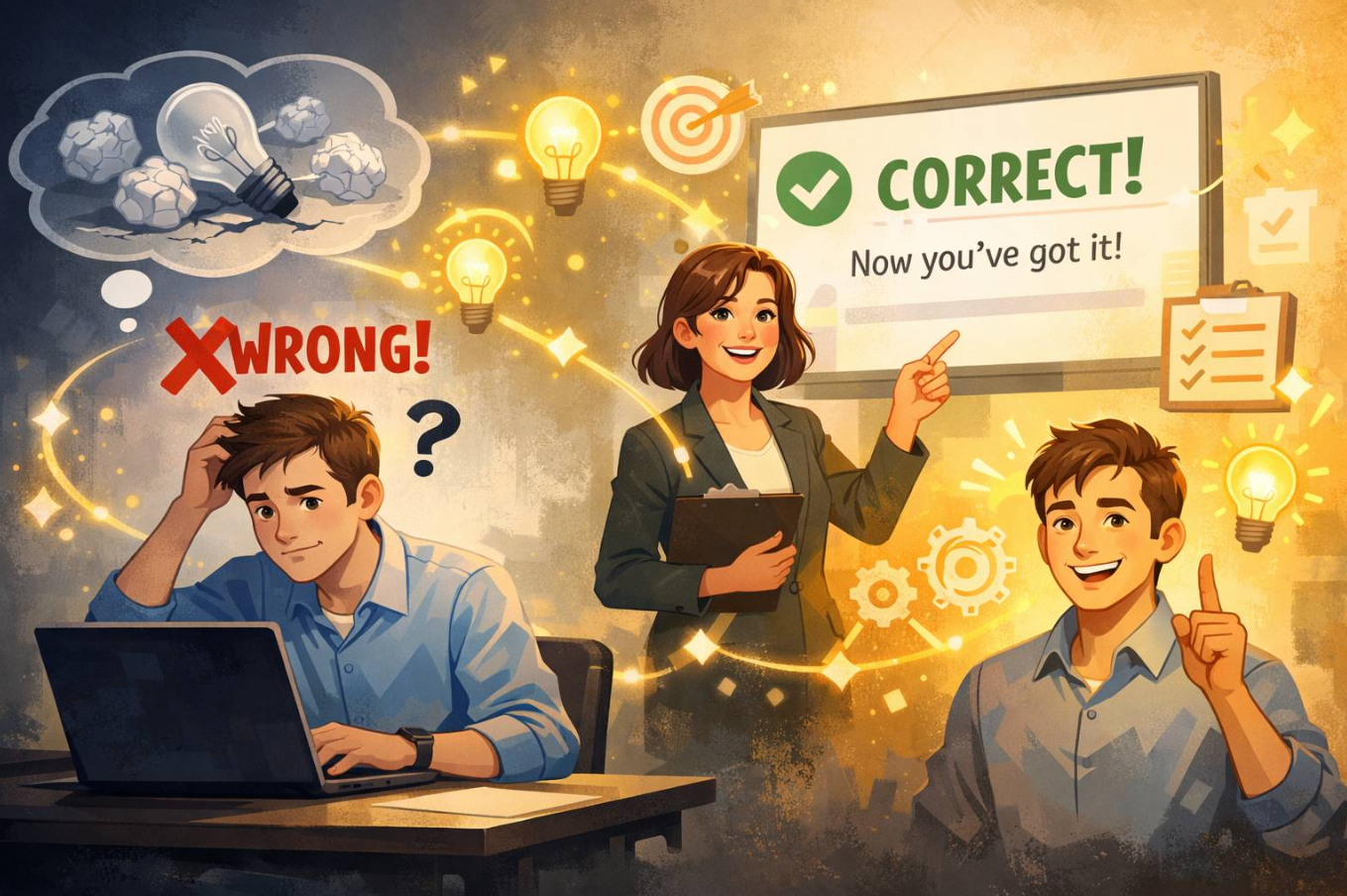
Before you read another word:
During a typical 20-minute video lecture, what percentage of learners are actively mind-wandering at any given moment?
Take a guess.
Research consistently finds that a third to more than half of learners are mind-wandering during a video lecture — and the rate climbs as the session goes on.
You’ll remember that number better because you tried to retrieve it first.
That tension you felt? That tiny flicker of uncertainty?
That’s the mechanism.
And if your courses don’t create that feeling on purpose, you’re designing for comfort — not retention.
The uncomfortable truth for L&D
Most training starts like this:
- Objectives.
- Agenda.
- Definitions.
- “Here’s what you need to know.”
Translation: cognitive sedative.
If your course begins with a content dump, you’re actively suppressing attention. If your SME says, “They need the information first,” that’s not rigor. That’s risk avoidance.
Brains don’t wake up for information.
They wake up for problems.
The Pretesting Effect (and why failure works)
Here’s the counterintuitive finding:
Students who attempt to answer questions before studying consistently outperform students who spend that same time just reading.
Not students who guess correctly.
Students who guess wrong.
In a landmark 2009 study, Richland, Kornell, and Kao had participants answer questions about a passage before reading it. Most got nearly everything wrong. After reading, the pretest group dramatically outperformed the group that had simply studied longer — even when researchers analyzed only the questions participants got wrong on the pretest.
Let that sink in.
Protecting learners from wrong answers might be exactly backwards.
Quick prediction
Why do you think guessing wrong helps?
A) It increases effort
B) It activates prior knowledge
C) It boosts confidence
D) It reduces anxiety
Here’s what’s actually happening.
What’s happening in the brain
When someone guesses incorrectly, three things fire before they ever see the right answer.
1. Activation.
The wrong guess lights up related concepts already stored in memory. Those become hooks. When the correct answer arrives, it has something to attach to.
2. Prediction error.
The mismatch between guess and reality registers as “this matters.” The brain treats it as a learning signal stronger than passively reading a fact.
3. Attention stabilization.
Pan, Sana, Schmitt, and Bjork (2020) measured attention during online lectures. Learners who took pretests beforehand wandered significantly less. They weren’t passively watching. They were hunting.
The wrong answer primes the brain.
The right answer completes the circuit.
And here’s the business implication
Mind-wandering isn’t just a learning problem.
It’s a performance cost.
If half your workforce is zoning out during compliance, onboarding, or product training:
- Ramp-up slows.
- Errors rise.
- Rework increases.
- Stakeholder trust erodes.
Attention is the most expensive resource in your organization.
And most training spends it carelessly.
Two design myths to retire immediately
Myth 1: Learners are blank slates.
They’re not. They arrive with fragments, assumptions, half-formed models. Pretesting activates them.
Myth 2: Wrong answers waste time.
They don’t. They create the conditions for durable learning.
Let me push this further:
If your opening slide is a learning objective instead of a question most learners will miss, you’ve already lost the brain.
Try this before your next module goes live
Pick the single most important concept in your course — the one that actually drives behavior change.
Now ask yourself:
If they had to answer a question about this right now, would most of them get it wrong?
If the answer is “no,” your content probably isn’t specific enough to matter.
Write one question most learners won’t answer correctly.
Not a trick.
Not unfair.
Just specific enough to require a real attempt.
Put it:
- In the intro email
- On the first slide
- At the top of the pre-work
- Anywhere learners first encounter the experience
Tell them there’s no penalty.
Then deliver a clear, satisfying answer.
One rule: don’t skip the reveal.
The question opens the loop.
The content must close it.
Want to amplify it?
Use tools like Mentimeter or a simple Google Form to collect guesses and display the group distribution before revealing the answer.
Now you’ve layered in social curiosity:
- “Was I the only one who thought that?”
- “Why did most people choose B?”
That tension compounds attention.
Final challenge
Before you scroll, answer this:
In your last course, did learners encounter a meaningful question they were likely to miss before they saw the content?
If not, you’re choosing clarity over impact.
And impact is what your stakeholders actually pay for.
Want to go deeper?
The foundational study
Richland, Kornell, and Kao (2009). The research that launched modern pretesting work. Start here if you need to persuade a skeptic.
→ Read the original pretesting research
Plain-English science
Faria Sana breaks down the mind-wandering findings without jargon.
→ Read the researcher’s explainer
Pretesting vs. retrieval practice
A practical comparison of when to place questions before vs. after study.
 Mike Taylor