
A practical crash course in performance-first thinking
It’s Tuesday at 2:47 PM when the Slack message arrives.
“We need a two-hour eLearning course on communication skills. By Friday.”
If you’re in L&D or instructional design, you probably fire back: What content should it include? Video or scenarios? Self-paced or instructor-led?
Here’s the uncomfortable truth: those questions, though they feel responsible, are the wrong starting point.
By asking them, you’re not diagnosing a problem. You’re taking an order.
I spent the first few years of my career as an order taker. Built beautiful courses. Stakeholders loved them—at first. Then nothing happened. The training became shelfware. And I couldn’t figure out why.
The answer had been sitting in performance improvement research for decades. Thomas Gilbert, Robert Mager, Peter Pipe, Roger Kaufman, Geary Rummler—these researchers documented a simple, counterintuitive insight:
Training is almost never the problem. So it’s rarely the solution.
What follows are the frameworks that help you figure out when training will actually work—and when it won’t.
The Big Idea: Performance Over Courses
Training is not the goal. Performance is.
That sounds obvious. But the implications are radical: if performance is the goal, then training is just one intervention among many—and usually not the most powerful one.
The Human Performance Technology (HPT) movement emerged from a frustrating pattern: organizations kept throwing training at problems, and the problems kept not getting solved.
What researchers found changed how I think about my entire job.
Part 1:
Start With Results, Not Courses (Roger Kaufman)
Needs vs. Wants
Roger Kaufman had a gift for dismantling comfortable language.
In organizations, we say: “We need a leadership workshop.” “We need communication training.” “We need a new LMS.”
Kaufman would stop you. Those aren’t needs, he’d say. They’re wants—preferred solutions dressed up as problems.
Here’s the distinction:
A Want: A specific solution (training, tools, systems)
A Need: A measurable gap between current results and desired results
When a stakeholder requests a course, they’re handing you a solution before anyone has defined the gap. Your job is to backtrack and find the actual result that’s missing.
The Outside-In Mindset
Kaufman’s Organizational Elements Model gives you a map for thinking backward from outcomes:
Mega: What value are we delivering to customers or society?
Macro: What must the organization produce to deliver that value?
Micro: What do people need to do daily to make that happen?
Most training starts at Micro—”employees need to learn X”—without confirming X actually drives results.
Here’s an example: A client asked for “better presentation skills training” for account managers. When I pushed to Macro level, the real organizational result they wanted was shorter sales cycles. When we dug into the data, presentations weren’t the problem. The proposal approval process was taking 18 days on average.
Takeaway: Never start with the course. Start with the measurable result the organization is missing.
Part 2: Check the Environment First (Thomas Gilbert)
You’ve identified a real performance gap. Now comes the next trap: assuming the gap exists because people don’t know how to do something.
Thomas Gilbert spent years studying human performance and landed on a blunt conclusion:
Most performance problems are caused by the environment, not the individual.
He’d measured it. Environmental factors drive performance roughly 75% of the time. Knowledge and skill? About 25%.
The Behavior Engineering Model
Gilbert organized this into six factors:
The Environment (fix these first):
- Data – Do people know what’s expected? Do they get clear, fast feedback?
- Instruments – Do they have the tools, systems, time, and resources to do the job?
- Incentives – Are we rewarding the right behaviors? Or accidentally punishing them?
The Individual (address these last):
- Knowledge – Do they know how to do the task?
- Capacity – Are they physically and mentally capable?
- Motives – Do they personally value the outcome?
Training primarily targets Box 4: Knowledge.
If Boxes 1, 2, or 3 are broken, training makes people better informed and still stuck.
Carl Binder adapted Gilbert’s original model to make it usable in real workplaces. The six boxes translate performance theory into a fast, practical diagnostic—so teams can spot the real constraint without becoming performance experts.
Learn more at sixboxes.com

What This Looks Like
A sales team was consistently missing quota. Leadership wanted “advanced negotiation training.”
But when we mapped the situation to Gilbert’s model, the problem was in Box 2—Instruments.
The CRM required 47 clicks to generate a customer proposal. By the time a salesperson assembled the pricing data, prospects had often moved on or gone around them to customer support.
We didn’t build a negotiation course. We fixed the CRM workflow and reduced proposal generation to eight clicks.
Quota problems disappeared within a quarter.
Takeaway: You can’t train your way out of unclear expectations, broken tools, bad incentives, or sabotaged workflows.
Part 3: Decide If It’s “Can’t Do” or “Won’t Do” (Mager & Pipe)
You’ve checked the environment. The tools work. Expectations are clear. Incentives align.
But the performance gap persists.
Robert Mager and Peter Pipe gave us something rare: a practical diagnostic tool you can use in real time. A flowchart. (I think it is the best flowchart of all time!)
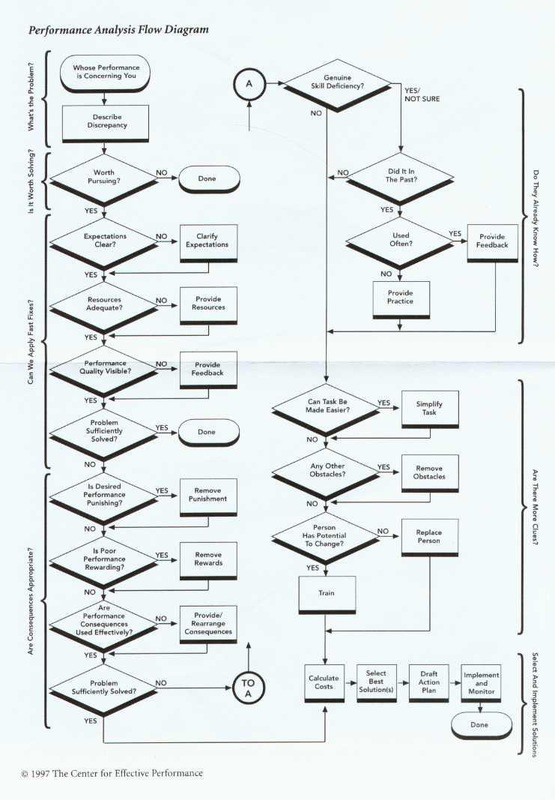
I keep a copy on my desk. It’s saved me from building useless training more times than I can count.
The Mager & Pipe Performance Flowchart
The genius of this flowchart is how it systematically walks you through a performance problem, ruling out non-training solutions one by one. Training only appears at the very end.
Here’s how it works:
Q1: Is the gap worth fixing? If the cost of fixing exceeds the cost of ignoring it, stop.
Q2: Could they do it if their life depended on it? (The “Gun Test”)
- If YES → It’s a “won’t do” problem. Check consequences and obstacles.
- If NO → It’s a “can’t do” problem. Continue below.
Q3: Are consequences aligned? Is doing it right rewarding? Is doing it wrong punishing? Or is it backwards?
Q4: Are there obstacles? Policies that contradict performance? Workflows that make the right thing harder? Remove obstacles first.
Q5: Did they ever do it correctly? If yes, they need practice or feedback—not necessarily training.
Q6: Can the task be simplified? Job aids, checklists, or workflow redesign often beat training.
Q7: Do they have the potential to learn it? Now training makes sense—with practice and feedback built in.
The Flowchart That Saved $200,000
A logistics company asked for “forklift safety recertification” for 400 warehouse workers. Budget: $200K. Reason: rising accident rates.
Here’s what walking the safety director through the flowchartmight look like.
Q1: Worth fixing? “Yes—insurance and damaged inventory are costing us more than training would.”
Q2: Could they do it safely if their life depended on it?
Long pause. “Actually… yes. When OSHA inspectors are on site, accidents drop to zero.”
Boom. That’s “won’t do,” not “can’t do.”
Q3: Consequences aligned?
Not even close. Productivity bonuses rewarded speed. Safe operation was slower—and therefore financially punished. Accidents had no real consequences.
Q4: Obstacles?
Several: tight warehouse corners, poor lighting, overdue forklift maintenance.
They didn’t build training.
Instead they:
- Fixed incentives (tied bonuses to productivity and safety)
- Improved lighting and warehouse layout
- Provided visible daily safety scoreboards
Cost: $35,000.
Results: 60% drop in accidents within three months.
Training budget: $0.
How to Use This
Get the flowchart from Mager and Pipe’s Analyzing Performance Problems (Chapter 2) or search “Mager Pipe performance flowchart” online. Print it. Keep it visible.
Next time someone requests training, walk through it together. Takes a little bit of time but saves months of wasted effort.
The flowchart turns “I think we need training” into an objective diagnostic. And here’s what you’ll discover: training is the solution to exactly one branch of that tree.
Takeaway: Training fixes “can’t do.” Management, systems, incentives, and workflow design fix “won’t do.” The flowchart tells you which one you’re dealing with.
Part 4: Fix the Workflow, Not Just the Worker (Geary Rummler)
Even with skilled people and clear goals, performance can still crater. Why?
Geary Rummler pointed out what most organizations miss: the structure fights the work.
Mind the White Space
Organizations are designed vertically—departments, functions, reporting lines. But work happens horizontally, across handoffs.
Marketing hands off to Sales. Sales hands off to Operations. Operations waits on IT. Everyone waits on approvals.
The gaps between these handoffs are what Rummler called the “white space” on the org chart. And they’re where work goes to die.
You can have brilliant performers, but if the process they’re trapped inside is broken, performance will suffer.
A Quick Example
An onboarding team was consistently missing deadlines. HR wanted “time management training.”
But when they mapped the workflow:
- HR completed paperwork (3 days)
- IT provisioned accounts (7 days)
- Facilities ordered equipment (5 days)
- The new hire’s manager was never told when to expect them
Total: 15+ days. Time management training wouldn’t have saved a single day—the problem wasn’t individual time management. It was a sequential process with no coordination.
They redesigned the workflow so steps happened in parallel and added automated notifications.
Onboarding time dropped to 5 days. No training required.
Takeaway: Before blaming individuals, look at the process they’re trapped inside.
When Training Actually Works
Let me be clear: I’m not anti-training.
Training can be the right solution—when conditions support it.
Training tends to work when:
- The task or system is genuinely new
- People get practice and feedback after training
- The environment already supports correct performance
- The problem is truly a knowledge or skill gap
Training is often necessary. It’s just rarely sufficient on its own.

A Simple Performance-First Decision Path
Here’s how to pull these frameworks together:
1. What result is missing? (Kaufman)
Define the measurable gap in performance—not the training, the outcome.
2. Is the environment set up for success? (Gilbert)
Check Data, Instruments, and Incentives before assuming it’s a knowledge problem.
3. Under ideal conditions, could people do the task? (Mager & Pipe)
If yes, fix the system. If no, consider training.
4. Is the workflow sabotaging performance? (Rummler)
Look at handoffs, delays, and white space—not just individual tasks.
Only then should you even think about opening your authoring tool.
Real-World Example: Communication Training That Wasn’t
A client contact center was drowning in customer complaints. The operations VP requested “communication skills training” for all 120 agents. Urgent, two-week turnaround.
They could have built it. Would’ve been a nice project fee.
But they used the frameworks:
Kaufman: The real result wasn’t “better communication”—it was a 30% reduction in repeat complaints within 60 days.
Gilbert (Data): Agents had no shared definition of “good communication.” Some were measured on call speed, others on satisfaction. The metrics conflicted.
Gilbert (Instruments): The CRM hid key customer information three clicks deep. Agents were asking customers to repeat information the company already had.
Gilbert (Incentives): Fast call resolution was rewarded. Thorough problem-solving wasn’t.
Mager & Pipe: When we asked, “Could agents resolve issues well if conditions were perfect?” the answer was yes—they already did when supervisors were watching.
Rummler: The workflow required agents to log issues in one system, but solutions were stored in another. No integration.
They didn’t build a communication course.
Instead:
- Defined clear communication standards
- Fixed the CRM interface
- Aligned metrics to prioritize resolution quality
- Integrated the ticketing and knowledge systems
Complaints dropped dramatically in a matter of weeks. Not a single PowerPoint slide required.
The Job You Were Actually Hired to Do
Moving from “course builder” to “performance consultant” can feel uncomfortable. It means asking harder questions, pushing back on stakeholders, sometimes saying “Training won’t fix this.”
But the pioneers of HPT taught us something crucial:
Our job isn’t to fill heads with knowledge. Our job is to improve performance.
Sometimes that means training. More often, it means fixing the world people work in.
The next time someone asks you for a course, pause.
Ask about the result they’re missing. Check the environment. Test whether it’s “can’t do” or “won’t do.” Look at the workflow.
You might still build training. But if you do, it’ll be the right training, at the right time, with the environment ready to support it.
And that’s when learning finally sticks.
Further Reading:
- Kaufman’s Needs Assessment
- Gilbert’s Human Competence
- Mager & Pipe’s Analyzing Performance Problems
- Rummler & Brache’s Improving Performance
Leave a Reply