NOTE: I’ve updated this post from the previous version to incorporate some new research shared by Julie Dirksen & Will Thalheimer.
Every learning designer knows the temptation.
You’ve built a solid course… but it still feels a little flat.
So you add a funny story.
Or a dramatic photo.
Or a splash of background music because “engagement!”
And just like that, you’ve stepped into one of the most reliable traps in instructional design: the seductive details effect—where interesting but irrelevant extras quietly pull attention away from the actual thing you need people to learn.
It’s one of those ideas that sounds small but has outsized consequences. And thanks to decades of research, we now know a lot more about when seductive details hurt learning, why they do it, and the few situations where they’re not as dangerous as they seem.
Let’s break it down.
Why Seductive Details Are So… Well, Seductive
Our brains love novelty. Tiny surprises. Little emotional jolts. Anything that fires up curiosity.
But in learning, that thrill comes at a cost.
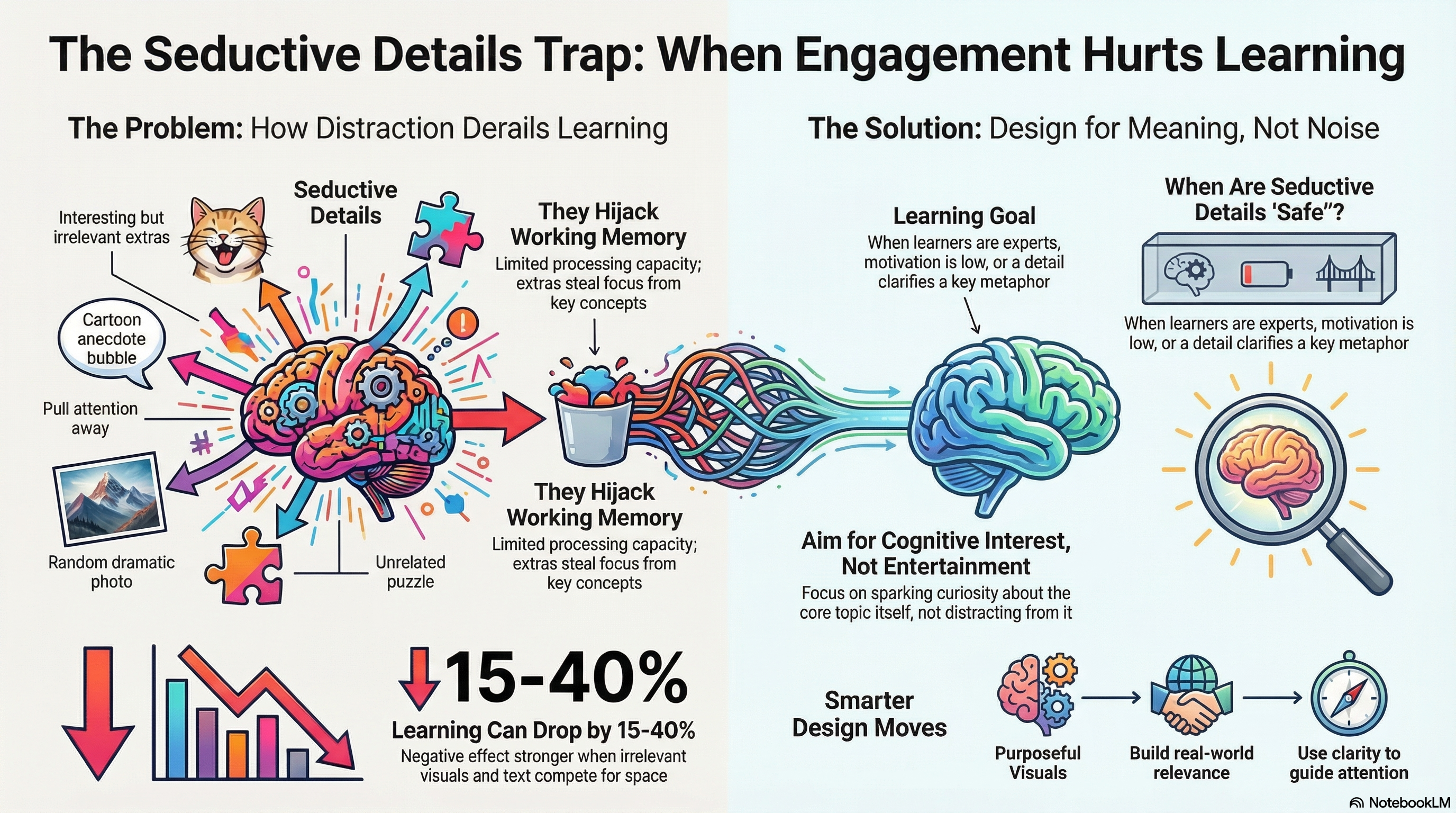
When you add content that’s fun but not necessary—like a quirky anecdote or a dramatic image—it forces the brain to split attention. Working memory is limited, and every extra bit of processing devoted to something irrelevant is attention not available for the concepts that actually matter.
And the hit isn’t small.
Across studies, irrelevant details reduce learning by an average of 15–40%, and the effect is even stronger when visuals and text fight for space on the same screen.
The punchline:
Attention spent elsewhere is learning lost.
What’s New (and Why the Story Isn’t as Simple as “Never Add Anything Fun”)
Older research painted seductive details as almost always harmful.
Newer research gives us a more realistic picture.
Here’s the nuance:
1. Prior knowledge matters. A lot.
Novices get derailed easily. Their working memory is already full, so even small distractions knock them off track.
But experts? They can often handle a decorative detail or two because they already have mental models to fall back on.
2. Motivation and emotion change the equation.
Seductive details can boost interest and reduce boredom—especially in long, self-paced programs.
That emotional lift might help people stick with a course they’d otherwise abandon.
3. The “dose” and placement make a huge difference.
A single visual at the periphery? Probably fine.
A funny sidebar next to a complex diagram? Probably not.
A story that runs longer than the actual lesson? Definitely not.
4. The effect is strongest in high-load content.
If the topic is complex, dense, or unfamiliar, even tiny distractions pull cognitive resources away from meaning-making.
5. The research you often see quoted comes from very short lessons.
Most classic seductive-detail studies use 3–5 minute learning segments followed by immediate tests—not the messy, multi-hour reality of workplace learning.
So: the effect is real, but size and severity vary.
So When Can You Use Seductive Details Without Wrecking Learning?
Here’s the short list:
- When learners already know enough to handle a little extra.
- When motivation is the bigger barrier than comprehension.
- When the detail creates emotional connection and you place it away from core content.
- When the detail helps build a metaphor that actually clarifies meaning.
Everything else? Probably not worth it.
What to Do Instead: Design for Cognitive Interest, Not Entertainment
If you want engagement that builds learning instead of derailing it, focus on what researchers call cognitive interest—the kind of curiosity that points people directly at the idea you want them to understand.
Here are safer, stronger design moves:
Use visuals with a job.
Show relationships. Reduce complexity. Guide the eye.
Skip the clip art holding a magnifying glass.
Build relevance, not decoration.
A scenario that mirrors the real workplace beats a funny aside every time.
Use contrast and clarity to draw attention.
People engage longer when content feels simple to navigate and easy to grasp.
Space key ideas across time.
Your best “engagement hack” is giving the brain room to breathe.
If you do add a story, keep it tight and directly connected to the learning point.
You don’t need a Marvel-level backstory. One crisp, relevant setup is enough.
The Bottom Line
Seductive details aren’t evil. They’re just expensive.
Sometimes the cost is worth paying—most of the time, it isn’t.
If your goal is learning that sticks, the safest bet is always the same:
Be intentional.
Be relevant.
Make the learning effortless to follow, and every detail earns its place.
Add delight, not distraction.
Add meaning, not noise.
That’s how you design content that respects attention—and actually gets results.
 Mike Taylor
One thought on “The Dangerous Allure of Distraction: Why Seductive Details Can Derail Learning (and When They Don’t)”