(A reading list that makes you useful, fast)
When someone new to learning design asks a reasonable question:
“What L&D books should I read?”
They usually get a long list of L&D books.
Models. Methods. Frameworks. More models.
Helpful… up to a point.
Because the real job of learning design isn’t “build a course.”
It’s help people do something differently—inside messy systems, with limited time, and zero patience for fluff.
That’s why the books that make you better at L&D often aren’t labeled “L&D.”
This list is built for one thing:
To help you stop building training that changes nothing—and start designing work that gets used.
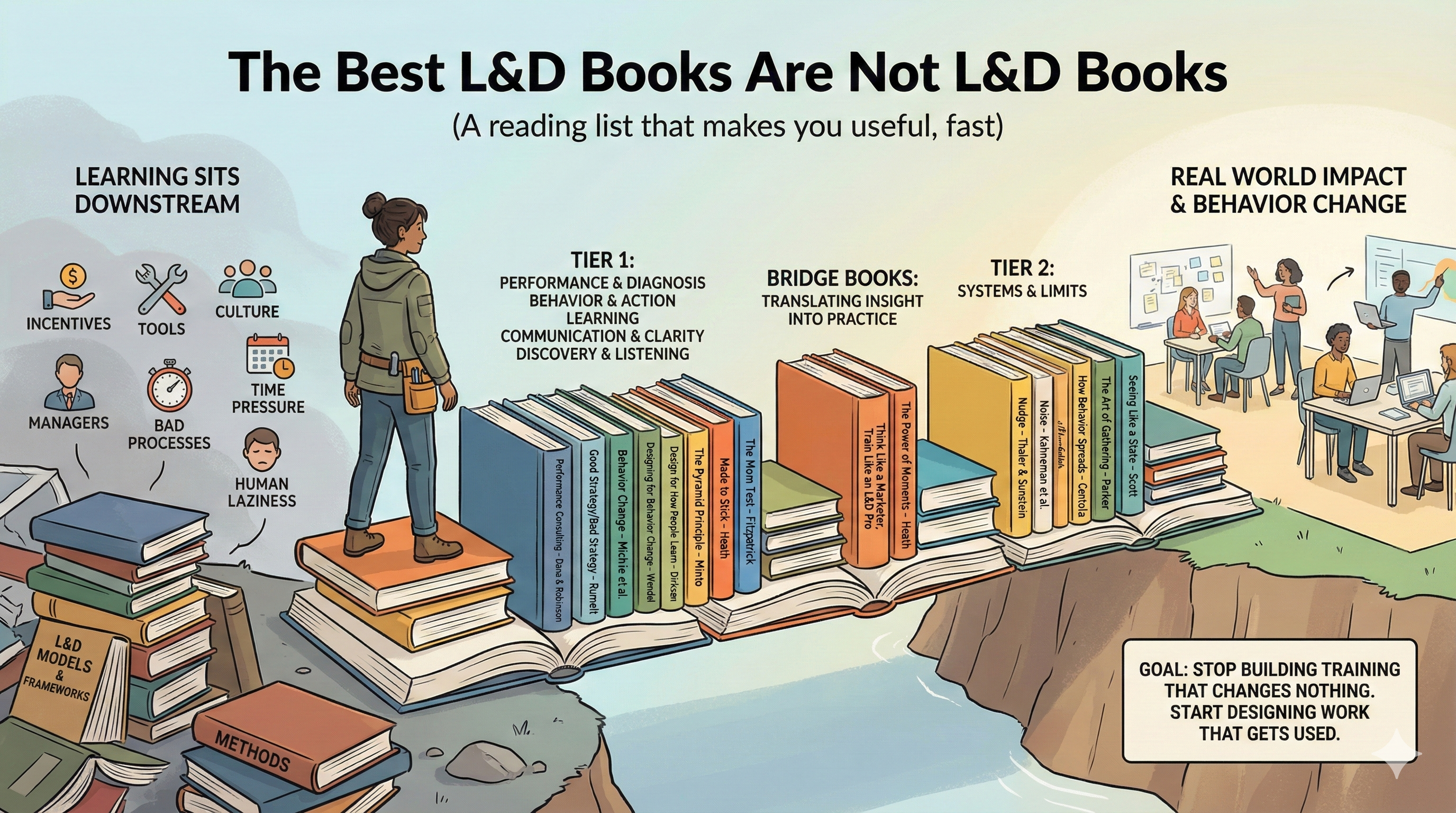
Learning sits downstream
Learning doesn’t live on an island. It lives inside:
- incentives
- tools
- culture
- managers
- time pressure
- bad processes
- and human laziness (the normal kind)
So if you only read learning books, you’ll get good at packaging information.
But behavior doesn’t move because information is well packaged.
Behavior moves because the situation changes.
Tier 1: Books that make you useful early
These are the books I’d hand to a new learning designer because they prevent the classic rookie mistake:
You build the thing you were asked for… instead of the thing that would help.
Performance & diagnosis
- Performance Consulting — Dana & Robinson
When you’re handed “we need training,” this teaches you how to ask, “Do we?” - Good Strategy / Bad Strategy — Richard Rumelt
When leaders give you goals and call it strategy, this shows you the difference.
Behavior & action
- Behavior Change — Susan Michie et al.
When people “know better” and still don’t do it, this tells you why. - Designing for Behavior Change — Stephen Wendel
When you need action, not awareness, this gives you levers you can actually pull.
Learning (when learning really is the lever)
- Design for How People Learn — Julie Dirksen
When learning is part of the solution, this keeps it focused, practical, and humane.
Communication & clarity
- The Pyramid Principle — Barbara Minto
When your content feels bloated, this teaches you how to think clearly first. - Made to Stick — Chip & Dan Heath
When your message doesn’t land, this shows you what makes ideas memorable.
Discovery & listening
- The Mom Test — Rob Fitzpatrick
When your “needs analysis” is basically polite guessing, this fixes it.
Tier 1 outcome:
You stop being an order-taker. You become a problem-solver.
Bridge Books: translating insight into practice
Some books aren’t foundations, and they aren’t slow-burn theory either.
They’re translation layers. They help you change your posture before you change your deliverables.
They move you from:
- content-first → audience-first
- delivery → demand
- push learning → create pull
A few that do this well:
- Think Like a Marketer, Train Like an L&D Pro
When you’re tired of “mandatory training” energy, this helps you earn attention and design for real humans.
https://www.amazon.com/Think-Like-Marketer-Train-Pro/dp/1960231197 - The Power of Moments — Chip & Dan Heath
When learning feels forgettable, this shows how to design moments people remember—and use.
Tier 2: Books that make you less naïve
Tier 2 is what you read after you ship good work… and still watch behavior resist.
These books teach you the limits.
And that’s a gift.
- Nudge — Thaler & Sunstein
When environment beats explanation (which is often), this shows how to design the path of least resistance. - Noise — Kahneman, Sibony, Sunstein
When inconsistency breaks trust and performance, this helps you see the hidden problem. - How Behavior Spreads — Damon Centola
When adoption stalls, this shows why broadcasting information isn’t enough. - The Art of Gathering — Priya Parker
When workshops and cohorts feel flat, this helps you design the social container. - Seeing Like a State — James C. Scott
When an organization wants a grand rollout, this teaches humility before you scale.
Tier 2 outcome:
You stop over-promising what learning can do on its own.
A note on the L&D classics
None of this is new.
Gilbert made environment and supports central to performance.
Mager & Pipe warned us not to reach for training first.
Clark & Mayer formalized how cognitive limits shape design.
So why recommend newer, non-L&D books?
Because most practitioners don’t struggle with theory.
They struggle with translation, influence, and getting results in modern workplaces.
These books often travel further because the language lands with more people.
This isn’t a replacement of the classics.
It’s an extension.
This isn’t anti-L&D
L&D books matter.
But they work best as integrators—books that help you apply ideas from behavior, systems, and communication to learning.
If you treat L&D as the whole world, you end up building content in a vacuum.
If you treat learning as one lever inside a system, you get much better results.
How to use this list (without turning it into homework)
- Start with Tier 1. Pick two and read with a project in mind.
- Add one bridge book. Use it to reshape how you pitch and package learning.
- Earn Tier 2. Read it after you’ve shipped work and want sharper judgment.
Don’t binge. Sequence.
Because the goal isn’t to be well-read.
It’s to be effective.
 Mike Taylor