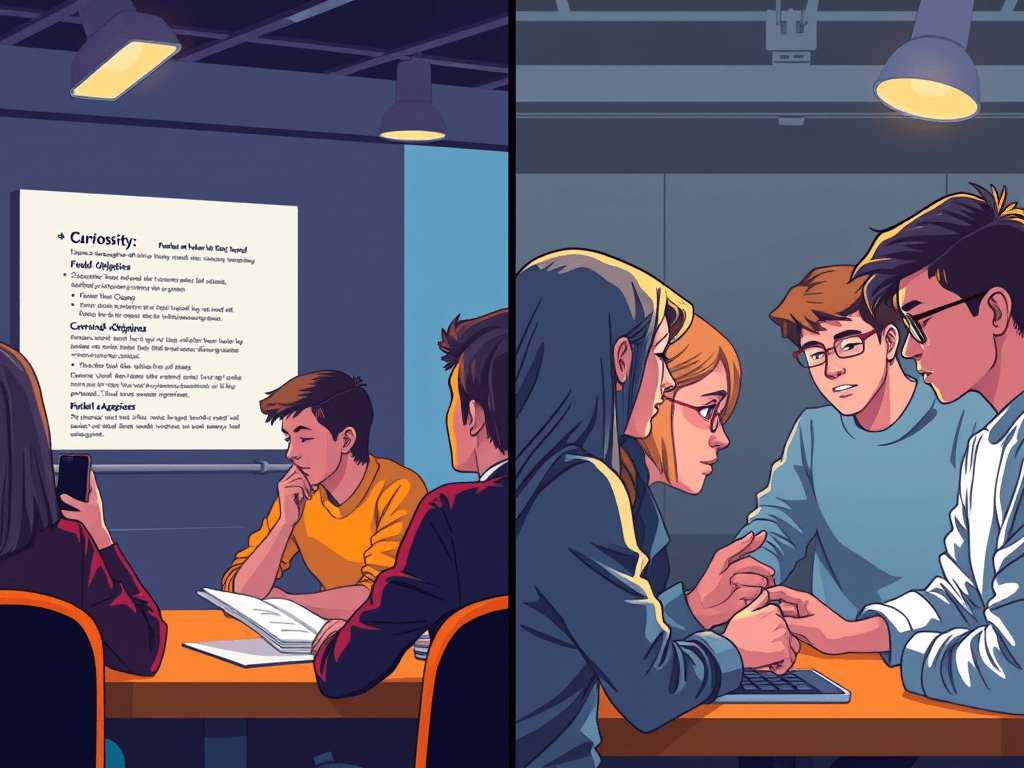
You spent three weeks on that compliance module. Got the objectives perfectly clear. Slide two, exactly where Gagne said they should be. Your instructional design was textbook.
Then you watched what happened: Learners skimmed the objectives and jumped ahead. Exit interviews revealed the pattern: “I knew what I was supposed to learn, so I didn’t pay attention to how.” Poor retention. Minimal application on the job.
Meanwhile, your colleague’s module—the one that starts with no objectives, just a failure scenario—had learners leaning forward, engaged, completing it in one sitting. Quiz performance was stronger. Six months later, managers reported better application.
It breaks every rule you were taught.
It works anyway.
Why?
The answer isn’t about engagement tactics or making training “fun.” It’s about something most instructional designers fundamentally misunderstand about how curiosity affects learning.
We think curiosity is the appetizer. It’s actually the main course.
The Conventional Wisdom Makes Perfect Sense
Robert Gagne’s Nine Events of Instruction have anchored systematic design for 40 years. For good reason. Event #2—”State the Objectives”—makes logical, ethical sense:
Learners deserve to know what’s expected. Objectives reduce anxiety. Clear expectations help learners organize information. Transparency respects their time.
Every instructional design certification teaches this. Every ADDIE process includes it. Lead with learning objectives? You’re being a responsible designer.
You’re also sabotaging the learning.
Not for the reason you think.
What We Got Wrong About Curiosity
Most of us carry the same assumption: Curiosity is an engagement tactic. Gets attention. Makes training feel less boring. It’s the motivational wrapper around the real content.
Curiosity = appetizer.
Learning = main course.
That’s backwards.
What if curiosity isn’t decoration for learning—what if curiosity is how learning happens?
What Loewenstein Actually Discovered
In 1994, Carnegie Mellon psychologist George Loewenstein published research that should have changed everything.
Most people know the sound bite: curiosity is a “cognitive itch.”
They miss why that matters.
Loewenstein showed that curiosity isn’t a personality trait. Not a motivational boost. It’s a specific cognitive state triggered by a knowledge gap—the uncomfortable distance between what you know and what you realize you must know.
The itch only happens when you perceive something’s missing.
The critical insight: Curiosity requires just enough knowledge to recognize that the gap exists.
Too little knowledge? Confusion.
Too much knowledge? No gap.
Curiosity lives in between.
Most training never enters that zone.
Lead with learning objectives? You fill the hole before learners know there’s a hole to fill. You answer questions they haven’t asked yet. You solve problems they don’t feel.
The gap closes before it opens.
The Thing We’ve Been Getting Wrong
The conventional wisdom: Curiosity captures attention, then objectives structure the learning.
Curiosity = motivation.
Objectives = learning architecture.
The research tells a different story.
Twenty years after Loewenstein’s psychological framework, neuroscientists at UC Davis finally measured what curiosity does to memory. Matthias Gruber, Bernard Gelman, and Charan Ranganath put people in a brain scanner and had them learn trivia facts—some they were intensely curious about, others they didn’t care about at all.
The results were clear.
When people were curious, their brains showed two things: First, the same reward circuits that activate for food or money lit up for information. Curiosity isn’t just mental—it’s rewarding at a neurological level.
Second, and more importantly, the brain regions involved in memory formation showed dramatically enhanced activity.
Curious brains form stronger memories.
But here’s the finding that changes everything:
The memory enhancement wasn’t limited to the information they were curious about. When learners were in a curious state, they formed stronger memories for related information too—including details they weren’t specifically trying to learn.
Your compliance module just changed.
When you open with a knowledge gap about the $2M invoice error—before you explain the approval process—you’re potentially creating the same memory-enhancing state Gruber observed in the lab. While the research tested trivia, the underlying mechanism appears domain-general: the brain doesn’t distinguish between “curiosity about Beatles trivia” and “curiosity about approval checkpoints.” It responds to the knowledge gap itself.
The evidence suggests that curiosity-driven learning creates conditions where information sticks more effectively—not just the answer to the question, but the surrounding procedures, policies, and protocols you teach while learners are actively working to close the gap.
Loewenstein predicted this in 1994. Psychology.
Neuroscience confirmed it in 2014. Biology.
Most instructional designers still haven’t caught up.
Watch what happens in real time:
The learner sees three URLs. Almost identical. One cost $2M.
I know URLs. I know phishing. But I don’t know WHICH character matters.
Prior knowledge: activated.
Gap: perceived.
They lean forward. Character by character. Domain by domain. What am I missing?
Questions generated.
Attention locked.
When they spot it—that tiny subdomain difference—resolution floods in.
There.
That’s when memory formation happens most effectively. Not when they read the objectives slide listing “three types of phishing patterns to identify.” When they discover the pattern themselves while actively hunting for it.
That’s not engagement theater.
That’s learning.
The curiosity gap creates the conditions for deep processing—the productive mental work of building understanding that lasts.
Lead with objectives? Learners passively receive information.
Lead with gaps? They actively construct meaning.
This is why the “wrong” design wins.
Not because it’s more engaging. Because the design creates the cognitive conditions where memory formation is most effective.
The Gagne Question: Is This a Contradiction?
If you’re a Gagne loyalist—and if you’ve been trained in systematic instructional design—this sounds like throwing out proven frameworks for trendy engagement tactics.
It’s not.
Loewenstein didn’t disprove Gagne. He updated him with 30 years of neuroscience Gagne didn’t have in 1985.
Gagne was right that learners need objectives. Right that systematic design matters. Right that structure reduces cognitive load.
He just put Event #2 in the wrong spot.
Gagne assumed learners needed the destination before they’d take the first step. Loewenstein proved they need to want the destination first.
The objectives aren’t wrong.
The timing is.
The synthesis instructional design has been missing:
Keep Gagne’s structure. Create Loewenstein’s gap. Flip the sequence.
Traditional approach:
- State objectives (Event #2)
- Present content
- Practice
- Assess
Updated approach:
- Activate schema (give just enough context to perceive the gap)
- Open the gap (present the failure, anomaly, or question)
- Sustain the gap (reveal information gradually as they work to close it)
- Close the gap (NOW state the objectives—as the earned answer)
- Transfer the gap (create a new scenario where they apply the pattern)
The objectives still exist. Still provide structure and clarity.
They’re just repositioned as the answer to a question the learner is already asking.
The Implementation Problem: Why Most Designers Get This Wrong
Some designers try this once and fail.
What usually goes wrong? They confuse mystery with confusion—threw learners into a vague scenario where nobody knew what domain they were in, what to pay attention to, or whether they could even solve the problem, and working memory collapsed under the weight of too many unknowns competing for too few cognitive resources.
The training didn’t just fail to engage. It actively overwhelmed.
Then they concluded: “Curiosity gaps don’t work. Gagne was right all along.”
But that’s like saying vegetables don’t work because you served raw, unwashed potatoes.
The implementation was wrong. Not the principle.
Loewenstein’s research was clear. Curiosity only works when the gap is:
- Perceivable (learners can tell what they don’t know)
- Specific (the missing information is bounded, not infinite)
- Closeable (learners believe they can find the answer)
You can’t just throw learners into ambiguity and hope curiosity emerges. You need just enough frame to direct attention without spoiling the answer.
The frame prevents confusion. The gap triggers curiosity.
Compare these:
Bad gap (creates confusion):
“Here’s a $2M invoice error. Figure out what went wrong.”
What domain? Accounting? Data entry? Fraud?
What am I looking for? Everything? One thing?
Can I even solve this with what I know?
Anxiety spikes. Working memory overloads.
Good gap (creates curiosity):
“Three people approved this invoice before it went out. The amount was wrong from the first click. Your job: find which approval checkpoint failed—and why everyone missed it.”
Domain: clear (approval process)
Task: specific (identify the failed checkpoint)
Scope: bounded (it’s about process, not everything)
Gap: present (I don’t know which checkpoint or why it failed)
The second version gives learners orientation without answers. They know what to pay attention to. They don’t know what they’re going to discover.
That’s where curiosity lives.
Why Your SME Will Hate This (And How to Win Them Over)
The SME conversation usually goes like this:
“Why waste time on mystery? Just tell them what they need to know.”
Fair objection.
Here’s the reframe:
When you lead with answers, you’re adding to the pile of 2,000 things they’re supposed to remember. Most of it disappears within a week—you’ve seen the post-training assessment data.
When you lead with the problem, something different happens. The information you give them isn’t competing with 2,000 other facts. It’s the answer to a question they’re actively trying to solve. Research shows memory formation is more effective when learners encounter information in a curious state—when they’re working to close a knowledge gap.
The SME’s content doesn’t change. The sequence does.
You’re still giving them all five vulnerability types. Still covering every approval checkpoint. Still delivering the same expertise.
We’re just repositioning it from “information to memorize” to “answer to a problem they’re trying to solve.”
And the sequence determines whether their expertise becomes information that fades or knowledge that sticks.
The Working Memory Question You Can’t Ignore
Picture your learner staring at that objectives slide.
Their brain is working. But on what?
Reading the bullet points. Trying to figure out why this matters. Wondering when the real content starts. Checking Slack.
That’s mental effort. But it’s not productive mental effort. It’s not building understanding. It’s just… busy work for the brain.
Cognitive load theory has a name for this: extraneous load. Mental effort wasted on poor design instead of directed toward learning.
Now picture the same learner encountering the $2M invoice error scenario.
Their brain is still working. But now it’s working on: What checkpoint failed? Why did everyone miss it? What pattern am I not seeing?
That’s also mental effort. But this time, the effort IS the learning.
Current cognitive load theory distinguishes between two types of load:
Intrinsic load (inherent complexity of the material)—UNAVOIDABLE
Extraneous load (wasted mental effort from poor design)—ELIMINATE THIS
The goal isn’t to reduce all cognitive load. It’s to eliminate wasteful load so learners can direct their limited working memory toward productive cognitive processing.
Create a boring objectives slide? Extraneous load.
Create a confusing, unbounded mystery? Also extraneous load.
Create a bounded, directed knowledge gap? You minimize extraneous load while creating optimal conditions for learning.
The critical factor: Working memory capacity is limited. Research suggests we can hold about four chunks of information at once. During a curiosity gap, learners are holding:
- The question or problem
- Their activated prior knowledge
- Attention to relevant cues
- Meta-cognitive monitoring
Manageable—if you’ve provided the frame.
Without the frame? Add uncertainty about domain, confusion about task, anxiety about solvability. Working memory exceeds capacity. Extraneous load spikes. Confusion replaces curiosity.
The design principle:
Bounded + directed + solvable = optimal conditions for learning.
From Theory to Monday Morning: Redesigning Your Next Module
You probably have a module you’re working on right now.
Compliance training. Technical onboarding. Soft skills development.
Right now, it probably starts with objectives. A dutiful list of what learners will know and be able to do.
Your redesign framework:
Phase 1: Don’t Delete the Objectives—Delay Them
Your objectives aren’t wrong. Just premature. Move them from slide 2 to the moment after learners have encountered the problem the objectives solve.
Phase 2: Replace Event #2 with “Frame the Gap”
Open with three elements:
- Domain specification (what realm are we in?)
- Specific question (what don’t I know?)
- Bounded scope (how big is this problem?)
Traditional objectives: “By the end of this module, you will identify three types of phishing URLs and explain how each exploits user behavior.”
Framed gap: “Three employees clicked three different links last month. One lost their password. One leaked quarterly forecasts. One triggered a $2M breach. The URLs looked almost identical. Your job: find what the security team missed.”
Same learning outcome. Different entry point.
One spoils the answer. One creates the itch to know.
Phase 3: Reveal Information Gradually
Don’t dump the content. Unfold it.
Let learners predict before you explain. Show examples before you give the pattern. Make the resolution earned rather than delivered.
Phase 4: State Objectives as Resolution
NOW—after they’ve wrestled with the problem—tell them what they just learned:
“Those are the three phishing patterns most employees miss: subdomain spoofing, homograph attacks, and URL parameter injection. You just learned to identify all three in context. Now let’s practice on new examples.”
The objectives become the answer, not the assignment.
The One Thing to Audit Right Now
You don’t need to redesign your entire curriculum today.
Start with one diagnostic question:
In your next module, are you answering questions learners haven’t asked yet?
If yes, you’ve found your gap opportunity.
The fix isn’t complicated. It’s sequential. You’re not removing information. You’re reordering when it appears.
I’ve built a tool that walks you through exactly how to audit your modules for curiosity gaps—and how to redesign them without starting from scratch.
Try the Curiosity Audit:

It’ll show you where you’re spoiling answers, where you’re creating confusion instead of curiosity, and where you’re missing opportunities to turn passive content into active problem-solving.
The Bigger Picture
This isn’t about making training “fun.”
Not about engagement metrics or completion rates.
It’s about designing for how memory actually works.
The research is clear: Curiosity creates conditions where memory formation is enhanced. When you create the gap first, you’re not just capturing attention—you’re creating the conditions where the information you worked so hard to design actually sticks.
The question isn’t whether to use systematic design or curiosity-first design.
It’s how to synthesize both.
Structure that creates productive cognitive processing instead of passive information consumption.
If you aren’t digging holes before you fill them, you aren’t teaching. You’re just reciting.
Your next module starts Monday.
Slide two is waiting.
What will you do with it?
References
Gagné, R. M., Briggs, L. J., & Wager, W. W. (1992). Principles of instructional design (4th ed.). Fort Worth, TX: Harcourt Brace Jovanovich College Publishers.
Gruber, M. J., Gelman, B. D., & Ranganath, C. (2014). States of curiosity modulate hippocampus-dependent learning via the dopaminergic circuit. Neuron, 84(2), 486-496. https://doi.org/10.1016/j.neuron.2014.08.060
Loewenstein, G. (1994). The psychology of curiosity: A review and reinterpretation. Psychological Bulletin, 116(1), 75-98. https://doi.org/10.1037/0033-2909.116.1.75
Sweller, J., van Merriënboer, J. J. G., & Paas, F. (2019). Cognitive architecture and instructional design: 20 years later. Educational Psychology Review, 31(2), 261-292. https://doi.org/10.1007/s10648-019-09465-5
Want more like this? The thinking in this post comes from Think Like a Marketer, Train Like an L&D Pro—a deeper dive into applying behavioral science and marketing psychology to learning design.
#TrainLikeAMarkter #InstructionalDesign #LearningScience #CuriosityGap #CognitivePsychology
 Mike Taylor