
How Dual Coding Theory Explains (and Fixes) Your Biggest Learning Design Problem Your learners look glazed over. They’re reading ahead while you talk. Or they’ve checked out entirely. You know what they’re doing? Choosing. Read the slide or listen to you. Not both. They can’t. And it’s not their fault—it’s your design. Your Brain ProcessesContinueContinue reading “The Dual Coding Problem: Why Your Learners Keep Tuning You Out”
Category Archives: Learning Science
The Best L&D Books Are Not L&D Books
(A reading list that makes you useful, fast) When someone new to learning design asks a reasonable question: “What L&D books should I read?” They usually get a long list of L&D books.Models. Methods. Frameworks. More models. Helpful… up to a point. Because the real job of learning design isn’t “build a course.” It’s helpContinueContinue reading “The Best L&D Books Are Not L&D Books”
The Signaling Principle
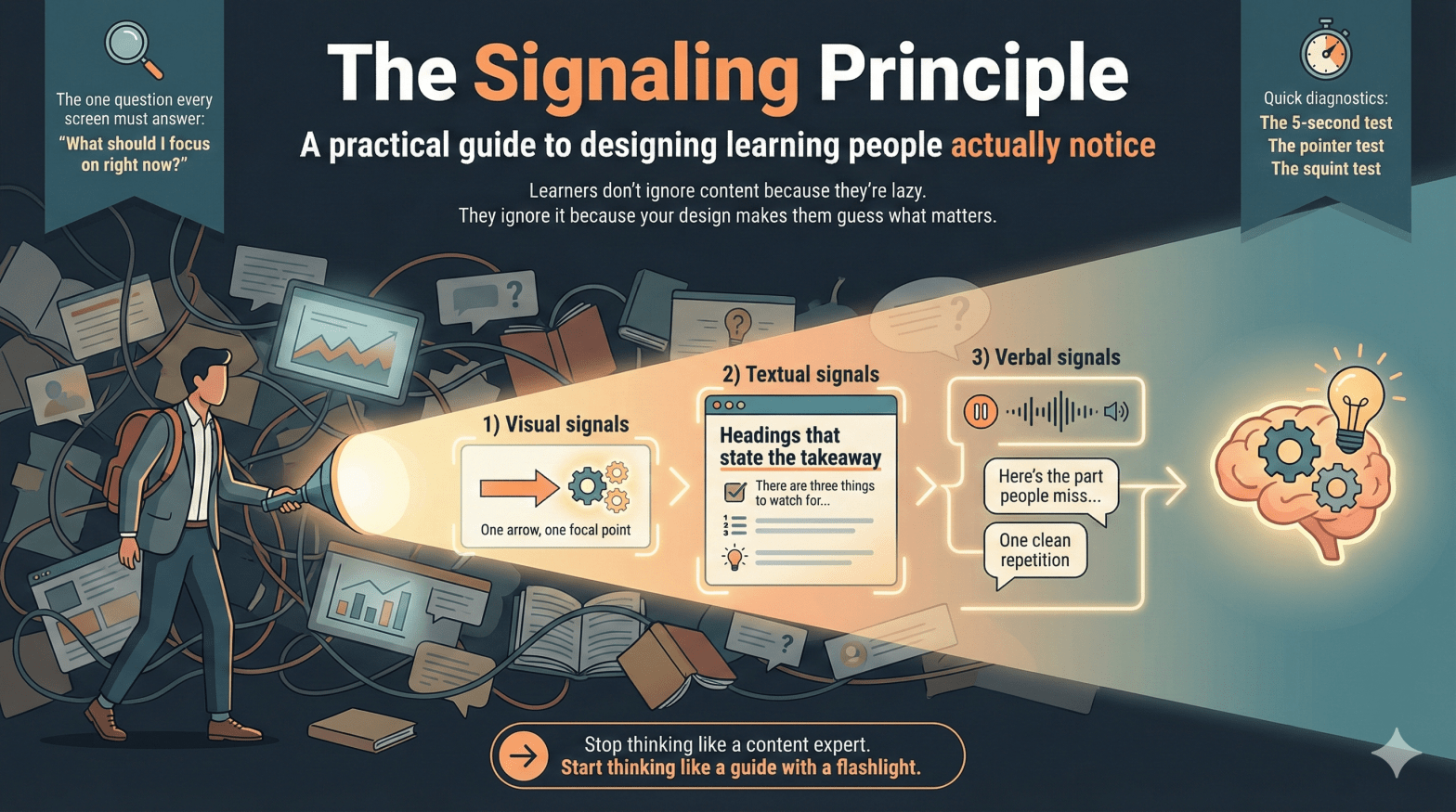
A practical guide to designing learning people actually notice Learners don’t ignore content because they’re lazy.They ignore it because your design makes them guess what matters. That’s the signaling principle (cueing). Signaling means you guide attention—on purpose.You make the important parts easy to spot and the unimportant parts easy to ignore. Why it works isContinueContinue reading “The Signaling Principle”
Most Instructional Designers Put This at the Start. Here’s Why YOU Shouldn’t!

You spent three weeks on that compliance module. Got the objectives perfectly clear. Slide two, exactly where Gagne said they should be. Your instructional design was textbook. Then you watched what happened: Learners skimmed the objectives and jumped ahead. Exit interviews revealed the pattern: “I knew what I was supposed to learn, so I didn’tContinueContinue reading “Most Instructional Designers Put This at the Start. Here’s Why YOU Shouldn’t!”
The Testing Effect: Why Retrieval Practice is Your Most Powerful Learning Tool
The Lie We Tell Ourselves Sarah’s quarterly review went well. Her compliance training program had a 94% completion rate. Everyone passed the quiz. Leadership was pleased. Three months later, a manager made a comment that clearly crossed the line. Nobody reported it. When HR investigated, five employees gave the same answer: “I didn’t know thatContinueContinue reading “The Testing Effect: Why Retrieval Practice is Your Most Powerful Learning Tool”
The Dangerous Allure of Distraction: Why Seductive Details Can Derail Learning (and When They Don’t)
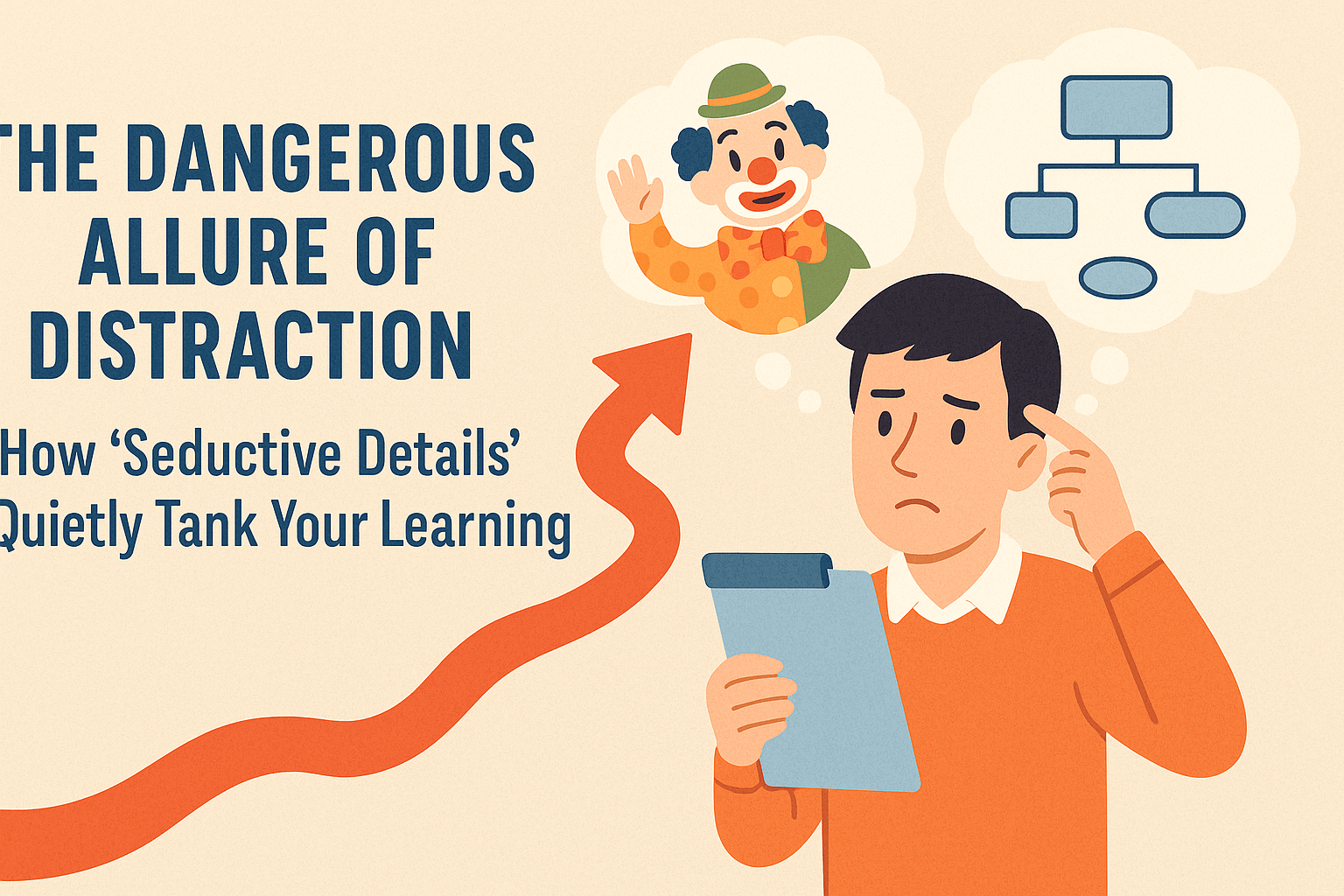
NOTE: I’ve updated this post from the previous version to incorporate some new research shared by Julie Dirksen & Will Thalheimer. Every learning designer knows the temptation. You’ve built a solid course… but it still feels a little flat.So you add a funny story.Or a dramatic photo.Or a splash of background music because “engagement!” AndContinueContinue reading “The Dangerous Allure of Distraction: Why Seductive Details Can Derail Learning (and When They Don’t)”
The Right Kind of Difficulty: Why Worked Examples Beat Practice for Novices

Evidence-Based L&D Series: Article 3 of 8 Picture Maria, three weeks into her new role as a financial advisor. Her manager has just assigned her first real client—a 52-year-old teacher who needs retirement planning. Maria opens the spreadsheet. Stares at it. Closes it. Opens the training manual. Scans for the formula. Tries a calculation. GetsContinueContinue reading “The Right Kind of Difficulty: Why Worked Examples Beat Practice for Novices”
Embracing Productive Failure: Why Getting it Wrong First Might Be the Right Approach

A counterintuitive learning strategy that’s changing how we think about instruction Here’s a wild idea: What if we told learners to dive into complex problems before we taught them how to solve them? What if we let them struggle, make mistakes, and yes—even fail—before stepping in with our carefully crafted lessons? If that sounds backwards to you,ContinueContinue reading “Embracing Productive Failure: Why Getting it Wrong First Might Be the Right Approach”
Friday Finds — Dual Coding, Behavioral Science Books, Blurry Backgrounds FTW
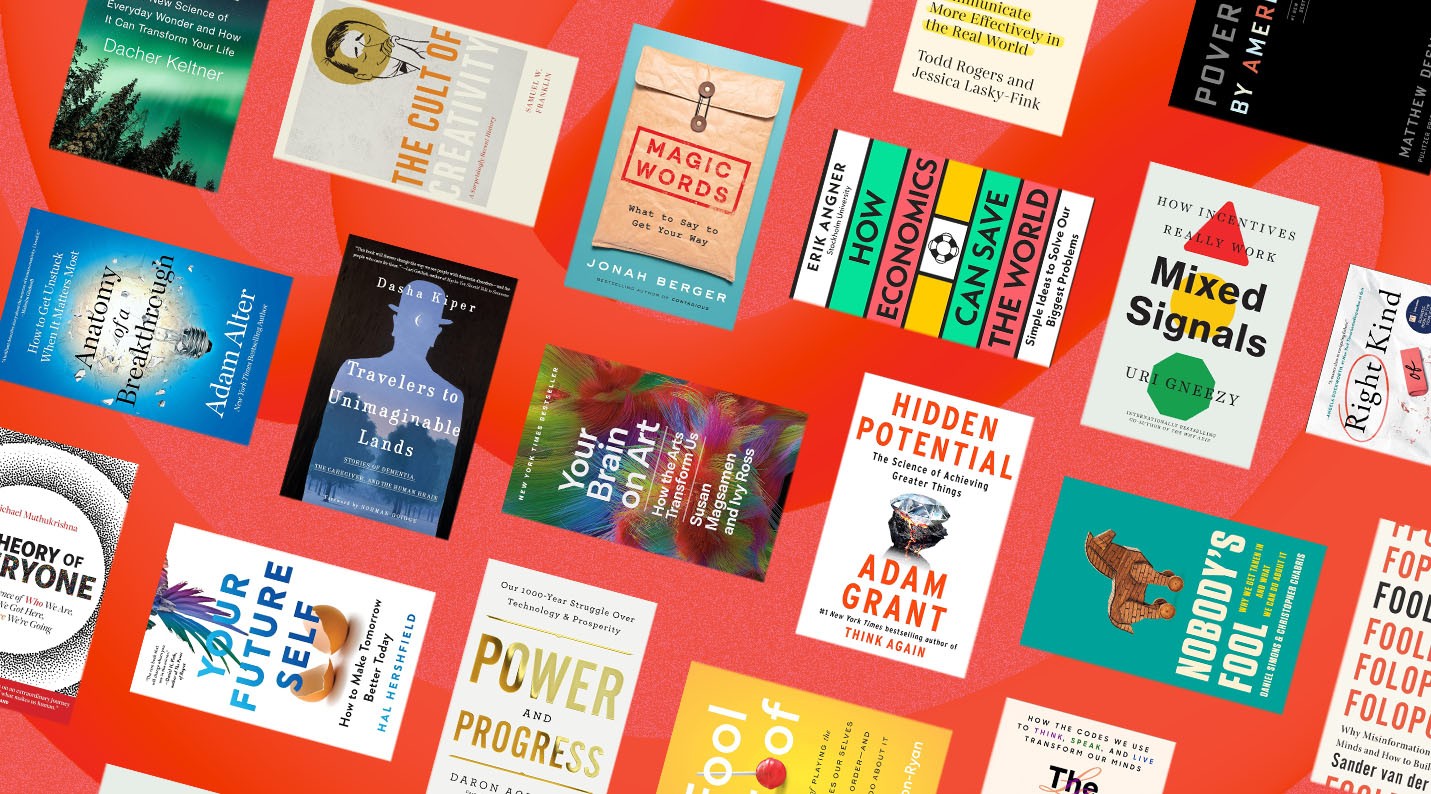
sponsored by iSpring Sign up here to get Friday Finds in your inbox every Friday “Human beings are never gonna be perfect, Roy. The best we can do is to keep asking for help and accepting it when you can. And if you keep on doing that, you’ll always be moving towards better.” — HigginsContinueContinue reading “Friday Finds — Dual Coding, Behavioral Science Books, Blurry Backgrounds FTW”
Learning Science: The Coherence Principle Decoded
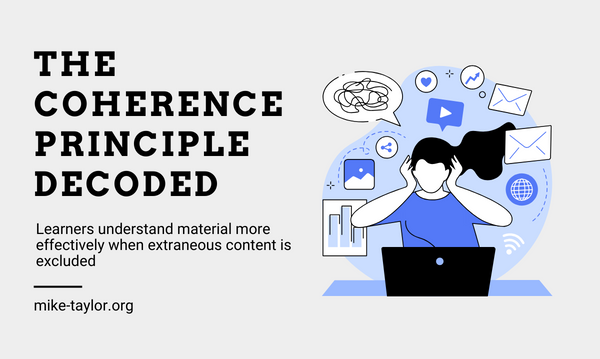
Picture this: I’m fresh on the scene as a new learning designer, proud of my first course about the pH of water systems in a coal-fired power plant. To ‘spice things up,’ I throw in a fun fact about the pH of beer. The result? A confused audience and a diluted message. It’s a pitfallContinueContinue reading “Learning Science: The Coherence Principle Decoded”
 Mike Taylor